
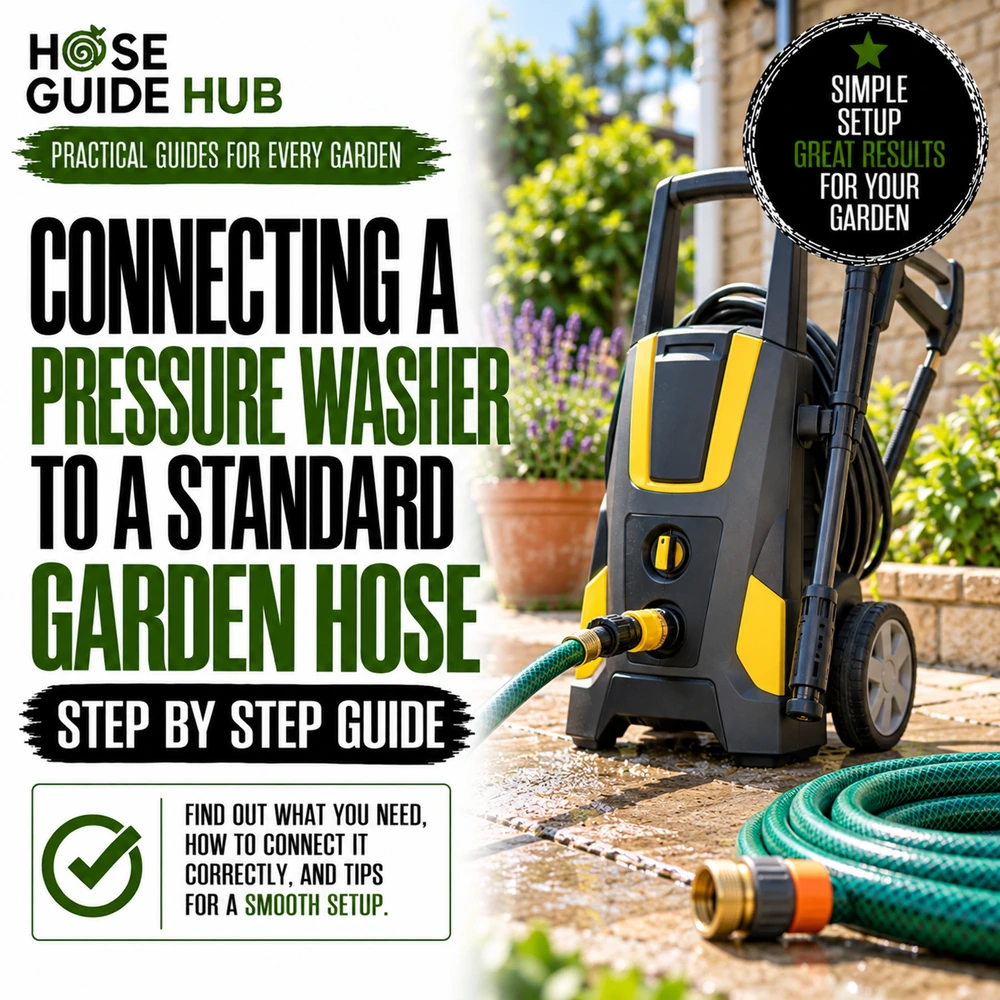
Connecting a Pressure Washer to a Standard Garden Hose: Step-by-Step Guide
Every pressure washer sold for home use runs on ordinary tap water, and that water reaches the machine through the same rubber hose already coiled up next to your flower beds. If you’ve been searching for how to use a pressure washer with a garden hose, here’s the short version: connect the hose to the water inlet, turn on the spigot before you touch the power switch, and let the pump do its job. The tricky part isn’t the concept. It’s the half-dozen small details that separate a smooth first run from a sputtering motor, an overheated pump, or a hose that splits under pressure it was never built for.
Almost every “my pressure washer won’t build pressure” complaint traces back to the hose connection, not the machine itself. So here’s the process laid out properly, one fitting at a time.
Disclosure: As an Amazon Associate, we earn from qualifying purchases made through links on this site. Learn more.
Quick Answer
Flush the hose for about ten seconds, thread it onto the pressure washer’s water inlet hand-tight, connect the other end to the spigot, then turn the water on and hold the trigger open for 30 to 60 seconds to bleed the air out before starting the machine. Use a 5/8 inch hose no longer than 50 feet for most residential pressure washers, and never start the engine or motor before water is flowing through the system.
What Do You Need Before You Start?
You don’t need much. Most of this is already sitting in your garage.
- A standard garden hose, ideally 5/8 inch in diameter and no longer than 50 feet
- The pressure washer itself, gas or electric; the steps are nearly identical
- Rubber washers or O-rings for the hose fittings (check the ones already inside the connectors)
- An outdoor spigot with reasonable water flow
- A hose-end filter or inline screen (optional, but cheap insurance for your pump)
- Pliers or a wrench, in case a fitting is stuck
That’s the full list. No adapters are required for a standard connection, since nearly every consumer pressure washer ships with a garden-hose-threaded inlet already built in.
Why Does Garden Hose Flow Actually Matter?
GPM and PSI Aren’t the Same Thing
People mix these up constantly. PSI, pounds per square inch, is the pressure your washer creates once water is inside the pump. GPM, gallons per minute, is how much water your hose can actually deliver to that pump in the first place. A pressure washer rated at 2,300 PSI and 1.5 GPM needs that 1.5 gallons every minute flowing in, or the pump starts pulling air. That’s called cavitation, and it’s one of the fastest ways to wreck a pump seal.
Most residential garden hoses supply far more water than any consumer pressure washer needs, so this rarely causes trouble on its own. It becomes a real issue when the hose is thin, badly kinked, unusually long, or shared with another fixture running at the same time.
Garden Hose Diameter Cheat Sheet
| Hose Diameter | Typical Flow Rate | Best For |
| 1/2 inch | 6–9 GPM | Small electric pressure washers only |
| 5/8 inch | 9–17 GPM | Most residential pressure washers (recommended) |
| 3/4 inch | 20–23 GPM | Commercial-grade or gas pressure washers |
If your pressure washer’s manual lists a minimum GPM requirement, a 5/8 inch hose covers nearly every situation homeowners run into. Stick with a thinner 1/2 inch hose only if you’re running a small electric unit under roughly 1,600 PSI.
Step-by-Step: Connecting Your Pressure Washer to a Garden Hose
Step 1: Inspect Your Hose and Fittings
Run water through the hose by itself first, away from the pressure washer. You’re checking for splits, leaks at the connectors, and steady flow. A worn washer or cracked fitting shows up here, and it’s far easier to fix now than after everything’s already hooked together.
Step 2: Flush the Hose Before Connecting It
This step gets skipped constantly, and it’s the reason so many pressure washer inlet screens clog within the first month of use. Turn the spigot on and let water run through the open hose for about ten seconds. That clears out sand, grit, and any debris left sitting in the hose from the last time you used it, before it ever reaches your pump.
Step 3: Attach the Hose to the Pressure Washer’s Water Inlet
Find the inlet on the pressure washer, usually marked with a small water-drop icon next to a threaded connector with a built-in filter screen. Screw the garden hose onto this inlet by hand until it’s snug. Hand-tight is enough for a garden hose fitting; over-tightening with pliers can crack the plastic housing on many consumer models.
Step 4: Connect the Other End to the Spigot
Attach the free end of the hose to your outdoor faucet. Make sure the washer inside the female fitting is seated properly, since a missing or worn washer is the single most common cause of a slow drip at this joint.
Step 5: Turn the Water On Before Starting the Machine
This step is non-negotiable. Open the spigot fully and let water flow through the entire system, including out through the pressure washer’s spray gun with the trigger held open, before you start the engine or plug the unit in. Running the pump dry, even for a few seconds, can damage the internal seals permanently.
Step 6: Bleed the Air Out of the System
With the water running and the trigger squeezed, you’ll see sputtering and inconsistent flow from the nozzle at first. That’s trapped air working its way out of the hose and pump. Keep the trigger held for 30 to 60 seconds until the flow evens out into a steady stream with no spitting or air pockets.
Step 7: Start the Machine and Test at Low Pressure
Only now should you start the engine on a gas model or switch on the motor on an electric one. Squeeze the trigger and check for a consistent spray pattern. If your machine uses interchangeable nozzle tips, start with a wide-angle tip, 25 or 40 degrees, rather than the narrow zero-degree tip, just to confirm everything’s working before you aim anything more aggressive at a surface.
Common Connection Problems and Quick Fixes
| Problem | Likely Cause | Fix |
| No water from the gun | Spigot not fully open, or air still trapped | Fully open the tap, hold the trigger open for 60 seconds |
| Pressure keeps dropping | Insufficient GPM or a kinked hose | Switch to a 5/8 inch hose, straighten kinks, check for a shared water source |
| Leak at the hose connection | Missing or worn washer | Replace the rubber washer inside the fitting |
| Grinding or knocking from the pump | Cavitation from air or low flow | Stop immediately, re-bleed the line, check hose length and diameter |
| Inlet screen keeps clogging | Hose wasn’t flushed before connecting | Flush the hose for 10–15 seconds before every connection |
| Machine won’t build pressure at all | Worn pump seals or a faulty unloader valve | Usually needs a technician; unrelated to the hose itself |
Gas vs Electric: Does the Hose Connection Change?
Not really. Both machine types use the same threaded garden-hose inlet, and the sequence, flush the hose, connect it, run the water, bleed the air, then start the machine, stays identical either way. The real difference shows up at Step 7. Gas engines need choke and throttle adjustments before they’ll fire, so there’s a bit more happening at the ignition stage. Electric units just need a switch flip once water is flowing cleanly. Neither type tolerates a dry start, so the water-before-power rule applies across the board.
Safety Habits Worth Building In
- Never point the spray gun at yourself, other people, or pets, even during the bleed-out step
- Keep electric cords and connections away from standing water and spray zones
- Check local rules before washing near storm drains, since detergent-laden runoff can violate wastewater regulations in some areas
- Turn off the water supply and engine before disconnecting or swapping fittings
- Store the hose drained and coiled to avoid cracks that show up as leaks the next time you connect it
Frequently Asked Questions
Can I Use a Pressure Washer With Well Water Instead of a Garden Hose From a Municipal Supply?
Yes, as long as the well pump delivers the GPM your pressure washer needs and the water is reasonably free of sediment. A sediment filter on the inlet line is a smart addition with well water, since grit tends to show up more often than with treated municipal supply.
Does My Pressure Washer Need Its Own Dedicated Hose?
Not strictly, but keeping one hose reserved for the pressure washer means fewer surprises down the line. A hose that’s spent years getting dragged across gravel driveways tends to carry more grit into your pump than one kept mainly for this purpose.
What If My Garden Hose Is Too Short to Reach the Job Site?
Connect two hoses together rather than buying one long hose specifically for the washer, but keep the total length under roughly 100 feet. Past that point, flow rate drops enough to matter, and cavitation becomes a real risk.
Can a Pressure Washer Damage a Standard Garden Hose?
The washer itself doesn’t push high pressure back through the garden hose. It draws water in at normal household pressure and multiplies it downstream, inside the pump and out through the nozzle. Your garden hose only ever handles regular tap pressure, so a hose in decent shape holds up fine over repeated use.