
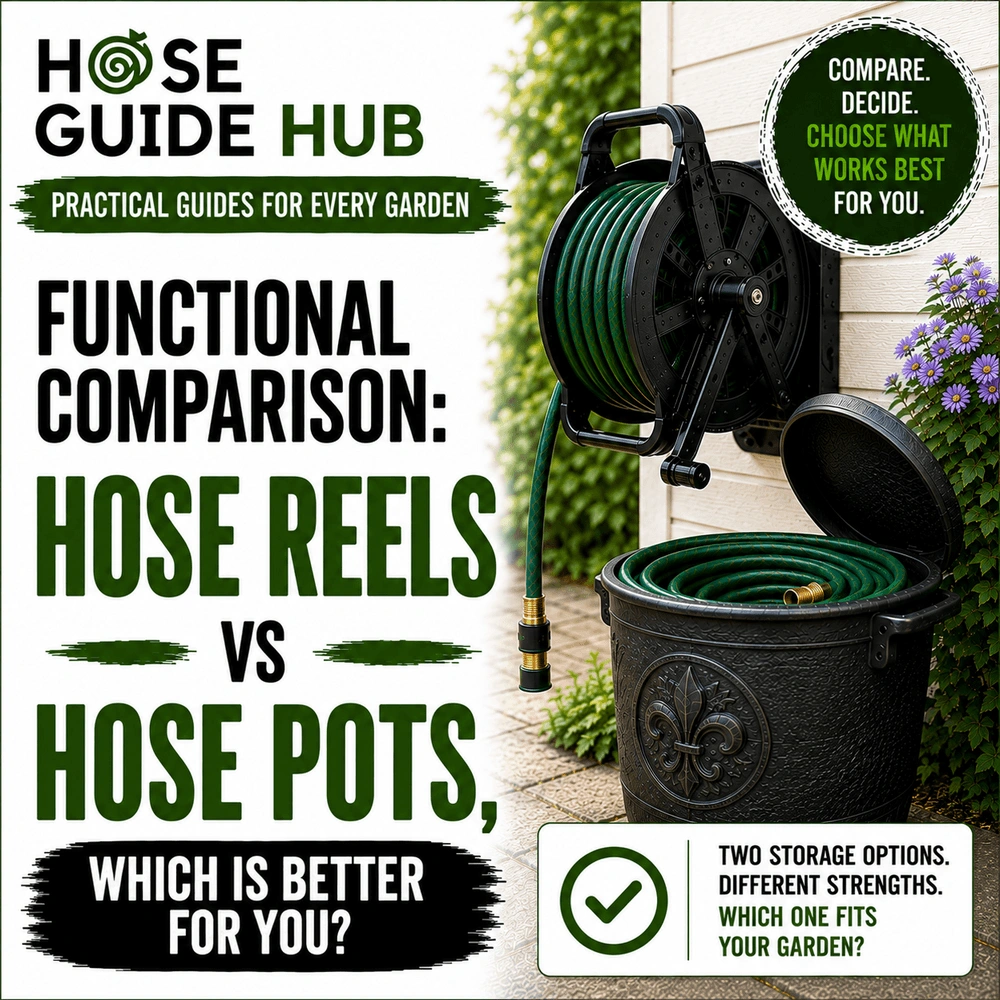
Functional Comparison: Hose Reels vs Hose Pots, Which Is Better for You?
Anyone who has tripped over a garden hose left in a heap on the lawn has probably wondered if there’s a better way to store the thing. The hose reel vs hose pot debate comes up constantly among home gardeners, and honestly, both solve the same basic problem in very different ways. A reel winds the hose up mechanically and keeps it under control. A pot just gives the coiled hose a tidy place to sit. Neither one is universally better, it depends on your yard, how often you water, and how much you care about the hose looking good sitting next to your porch. Here’s how they actually stack up.
Disclosure: As an Amazon Associate, we earn from qualifying purchases made through links on this site. Learn more.
What Each One Actually Is
Before comparing the two, it helps to be clear on what each option is actually doing for you, since they solve the storage problem from opposite directions.
Hose reels
A hose reel is a mechanical spool, either wall mounted, freestanding, or built into a cart, that winds the hose around a drum. Most have a crank handle or a spring loaded auto rewind mechanism, and many include a guide arm that keeps the hose winding evenly instead of piling up on one side. The hose stays attached to the reel permanently in most designs, so you pull it out to use it and it winds back in when you’re done.
Decorative hose pots
A hose pot is essentially a container, often ceramic, resin, or stone look material, with a hole or notch near the base where the hose feeds through. You coil the hose by hand and drop it into the pot, and the pot hides the loops from view while giving them a defined space to sit. There’s no mechanism involved. It’s storage in the same sense a laundry basket stores towels.
Hose Reel vs Hose Pot: Side by Side Comparison
| Factor | Hose reel | Decorative pot |
| Hose protection from kinks | Strong, the reel controls how the hose winds | Weak, coils can twist and kink over time |
| Ease of retrieving the hose | Fast, pull and it feeds out on its own | Slower, you’re uncoiling by hand each time |
| Ease of putting it away | Fast with auto rewind, moderate with manual crank | Requires hand coiling every time |
| Mobility around the yard | High if it’s a cart style reel | Low, most are meant to stay in one spot |
| Weather resistance | Good, most are built for UV and rain exposure | Good, but material varies widely by product |
| Footprint and visual style | Functional look, some designs are more discreet | Blends into garden decor, chosen for looks first |
| Moving parts to maintain | Yes, spring or crank mechanism can wear out | None, there’s nothing to break |
| Best fit for hose length | Handles long hoses well, 75 to 100 feet | Better suited to shorter hoses under 50 feet |
How Each One Protects Your Hose
Reels and kink prevention
A hose that’s wound consistently around a drum holds its shape better over time than one coiled loosely by hand. Reels reduce the sharp folds that eventually crack a hose at the joint, which is one of the most common reasons hoses fail early. The guide arm on a quality reel also prevents the hose from stacking unevenly, which would otherwise put stress on one section more than the rest.
Pots and coil memory
Hoses coiled by hand tend to develop what’s sometimes called coil memory, meaning the hose starts holding a loose, wavy shape even when stretched out flat. This doesn’t damage the hose the way a hard kink does, but it does make the hose harder to lay straight and more prone to tangling the next time you pull it out. A hose pot doesn’t cause this on its own, it’s really a byproduct of hand coiling in general, but a pot doesn’t do anything to prevent it either.
Ease of Use: Winding vs Just Dropping It In
Manual crank reels
These require you to physically turn a handle to wind the hose back in. It’s more effort than an auto rewind system, but manual reels tend to have fewer parts that can fail and are usually simpler to fix if something does go wrong down the line.
Auto rewind reels
Auto rewind reels use a spring loaded mechanism, similar to a tape measure, that pulls the hose back in on its own once you release a lock or give it a tug. This is the fastest way to put a hose away, though the spring is also the part most likely to eventually need replacing.
Pots and simple coiling
There’s no wrong way to use a pot beyond making sure the hose isn’t kinked as you feed it in. The tradeoff is that every single use involves bending down and coiling loop after loop by hand, which some people don’t mind and others find tedious after the first few weeks.
Which One Fits Your Property Better
Small patios and courtyards
A hose pot often wins here. Shorter hoses under 50 feet coil easily, the pot itself can double as a decorative element, and there’s no need for the extra mechanical capacity a reel offers if you’re only watering a few containers.
Average suburban yards
This is where reels tend to pull ahead, mainly because of hose length. A 50 to 75 foot hose gets unwieldy to coil by hand repeatedly, and a wall mounted or cart reel handles that length with far less effort over the course of a season.
Larger properties with multiple watering zones
Reels, and often more than one of them, make more sense here. Long hoses paired with frequent use put real wear on a hose that’s hand coiled every time, and the time savings from a reel adds up fast when you’re watering multiple areas regularly.
Renters and non permanent setups
A freestanding pot has an edge for renters since it requires no mounting hardware and moves easily if you relocate. Cart style reels also work without installation, but wall mounted reels aren’t a great fit if you can’t drill into a rental property’s exterior.
Common Mistakes People Make With Each Option
- Choosing a pot for a hose over 75 feet, which turns coiling into a genuine chore
- Mounting a reel in direct, unshaded sun exposure without checking the housing material’s UV rating
- Assuming a pot protects the hose from weather the same way an enclosed reel housing does
- Buying an auto rewind reel without checking whether the tension is adjustable, since a fixed spring can feel too aggressive
- Picking a decorative pot too small for the actual coiled diameter of the hose, which forces awkward folding
Quick Decision Table
| Scenario | Better fit |
| Hose is under 40 feet and mostly used for containers or a small bed | Decorative pot |
| Hose is 50 feet or longer and used often | Hose reel |
| You want the hose storage to also look attractive on a patio | Decorative pot, or a reel with a housing built for that purpose |
| You’re watering multiple zones around a larger property | Hose reel, possibly more than one |
| You’re renting and can’t mount anything permanent | Freestanding pot or cart style reel |
Common Questions
Do hose pots damage the hose over time?
Not directly, but they don’t prevent the wear that comes from repeated hand coiling either. A hose stored in a pot for years will likely show more wavy coil memory than one that’s been consistently wound on a reel.
Are hose reels harder to install than pots?
Wall mounted reels need to be screwed into a solid surface, so there’s some setup involved. Cart style and freestanding reels need no installation at all, similar to a pot, you just place them where you want them.
Can I use a hose pot with a long hose?
You can, but it gets awkward past 50 feet. The coils get taller and heavier inside the pot, and pulling the hose out without tangling becomes more of a hassle the longer it is.
Which one lasts longer outdoors?
Both hold up well if the material is rated for outdoor use, but a reel’s moving parts, particularly the spring in auto rewind models, are the component most likely to eventually wear out. A pot has nothing mechanical to fail, so its lifespan mostly comes down to how the material itself handles sun and temperature swings.
Can I combine a hose pot and reel setup?
Some people do exactly this, using a small reel for a frequently used short hose near the door and a decorative pot for a second, less frequently used hose kept on the far side of the yard. There’s no rule that says a property has to pick one system for every spigot, and mixing the two often ends up being the most practical answer once you actually map out how the space gets used.
Long Term Upkeep: What Each One Actually Asks of You
Beyond the initial choice of hose reel vs hose pot debate, it’s worth thinking about what each option demands from you season after season, since that’s where the real difference shows up.
A reel with moving parts needs occasional attention. The spring on an auto rewind model can weaken over years of use, the guide arm can loosen, and the housing may need a wipe down if dirt builds up around the mechanism. None of this is difficult, but it is upkeep that a pot simply doesn’t require.
A hose pot asks nothing of you mechanically. There’s no spring to check and no crank to lubricate. The only real maintenance is making sure the material itself, whether that’s resin, ceramic, or a stone composite, isn’t cracking from freeze and thaw cycles if you leave it outside year round in a colder climate.
See our cast iron hose hanger product guide.