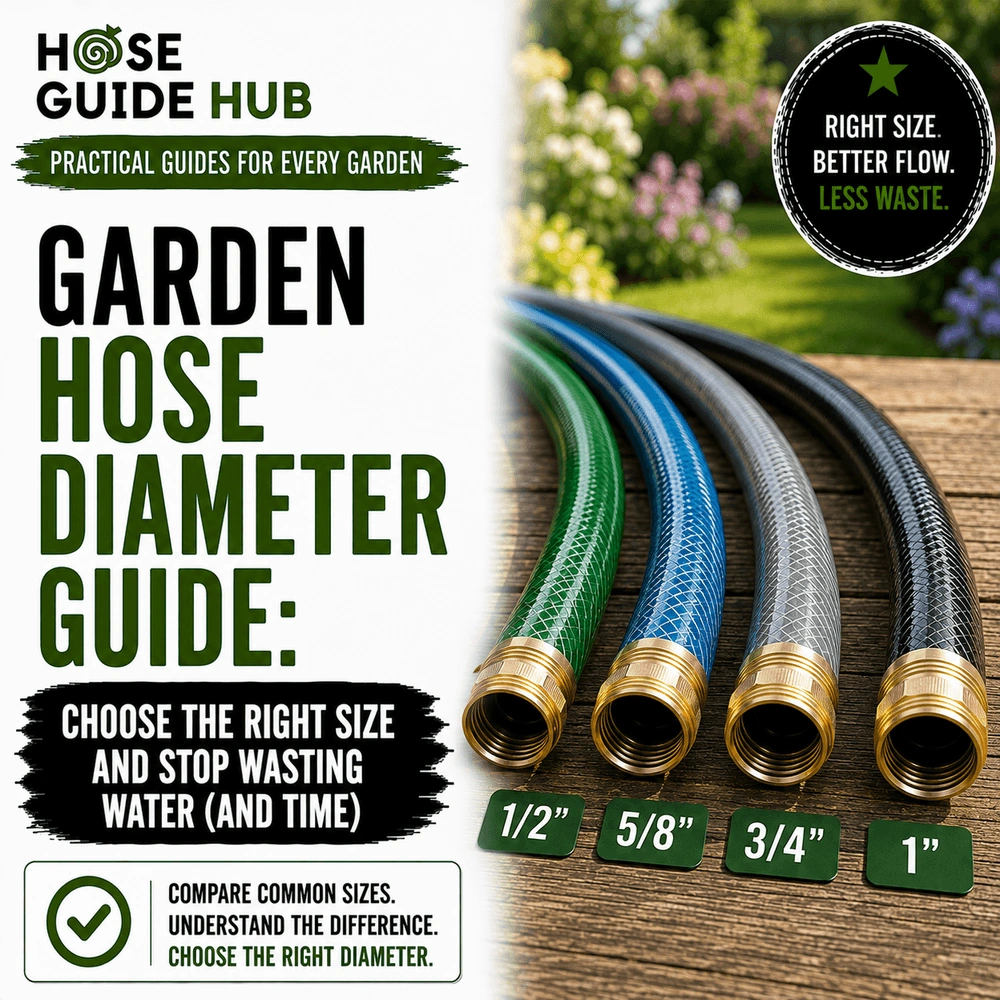
Garden Hose Diameter Guide: Choose The Right Size And Stop Wasting Water (And Time)
If you’ve ever stood in the garden aisle staring at hoses with no idea what the diameter numbers actually mean, you’re not alone. The garden hose diameter guide you actually need isn’t a pamphlet on the back of the packaging. It’s a real breakdown of what each size does, how much water it moves, and which one belongs in your yard. Pick the wrong diameter and you’ll either be waiting forever to fill a sprinkler system, or lugging around a hose that’s heavier than it needs to be.
This guide covers everything: the standard sizes, flow rates, fitting compatibility, thread specs, and a straight-to-the-point selector table so you can make the right call before you buy.
Disclosure: As an Amazon Associate, we earn from qualifying purchases made through links on this site. Learn more.
The Four Standard Garden Hose Diameters
Garden hoses sold in the United States come in four internal diameter sizes. The internal diameter (ID) is what matters for water flow; the outer diameter varies depending on the hose wall thickness and materials.
Hose Size Comparison at a Glance
| Diameter | Flow Rate (GPM)* | Best For | Weight & Handling | Typical Length |
| 1/2 inch | 5-6 GPM | Flower beds, potted plants, light tasks | Lightest, very easy to maneuver | 25-50 ft |
| 5/8 inch | 6-9 GPM | General home use, lawn, car washing | Moderate, still manageable | 50-100 ft |
| 3/4 inch | 10-14 GPM | Large lawns, irrigation, filling pools | Heavier, stiffer to coil | 50-100 ft |
| 1 inch | 14-17+ GPM | Commercial/farm use, fire suppression | Heavy, requires two hands | 50-100 ft |
*Flow rates based on approximately 40-60 PSI residential water pressure with open-ended hose. Actual rates vary by water pressure, hose condition, and attached fittings.
1/2-Inch Hose
This is the smallest commonly available diameter. It’s light, flexible, and dead simple to store. The tradeoff is flow: at around 5-6 gallons per minute, it won’t keep pace with heavy-demand tasks. For watering a small flower bed, hanging baskets, or patio containers, it’s perfectly suited. Anything bigger and you’ll feel the limitation.
5/8-Inch Hose (The Goldilocks Size)
This is the most popular diameter in North America, and with good reason. It delivers 6-9 GPM at typical residential pressure, which is enough for general lawn watering, washing a car, or running a standard oscillating sprinkler. It’s manageable to carry, fits standard fittings without adapters, and sits at a reasonable price point. If someone asks you what size to buy without giving you more context, 5/8-inch is the answer.
3/4-Inch Hose
Step up to 3/4-inch when the job demands volume. This size pushes 10-14 GPM, making it the right call for large lawns, multiple sprinkler zones, topping off a water feature, or powering a sprinkler system that runs multiple heads at once. The weight is noticeably more than a 5/8-inch hose, especially once it’s full of water. A 100-foot rubber 3/4-inch hose can feel genuinely heavy after a long garden session.
1-Inch Hose
Rare in residential settings. You’ll find 1-inch hoses on farms, construction sites, and in commercial landscaping. The flow rates exceed 14 GPM and can reach 17+ GPM at optimal pressure. Unless you’re managing a large property or filling large tanks regularly, this is overkill for a home garden. Most domestic faucets can’t supply water fast enough to take full advantage of a 1-inch hose anyway.
How Hose Length Cuts Your Flow Rate
Diameter is only part of the equation. Every extra foot of hose adds friction to the water moving through it, and that friction robs you of pressure and flow rate. The effect compounds the longer the hose runs. Going from 25 feet to 100 feet can cost you 20-30% of your flow rate, depending on the diameter.
Estimated Flow Rate by Hose Length (at ~50 PSI)
| Hose Length | 1/2″ Flow (GPM) | 5/8″ Flow (GPM) | 3/4″ Flow (GPM) | 1″ Flow (GPM) |
| 25 ft | ~6 | ~9 | ~13 | ~17 |
| 50 ft | ~5.5 | ~8 | ~12 | ~16 |
| 75 ft | ~5 | ~7 | ~11 | ~15 |
| 100 ft | ~4.5 | ~6.5 | ~10 | ~14 |
Estimates based on approximately 50 PSI inlet pressure. Results vary with hose condition, fittings, and actual supply pressure.
The practical takeaway: don’t buy more hose than you need. A 100-foot hose seems convenient until you realise you’re losing meaningful pressure at the end of it, and you’re storing and dragging 100 feet of rubber every time you water. Buy the length that reaches your furthest point and no more.
If you genuinely need to cover distance, connecting two shorter hoses of a larger diameter will outperform one long hose of a smaller diameter. A 3/4-inch hose at 100 feet beats a 1/2-inch hose at 100 feet by a wide margin.
Understanding Garden Hose Thread Sizes
Here’s where a lot of people get confused. The hose diameter and the fitting thread size are two separate measurements, and they don’t always match.
That means when you swap from a 5/8-inch hose to a 3/4-inch hose, your existing nozzles, sprinklers, and spigot connections will still fit. No adapters required.
GHT vs NPT vs BSP: Don’t Mix Them Up
Three thread standards show up in gardening and irrigation contexts. They look similar enough to cause expensive leaks if you mix them up.
Thread Standard Comparison
| Spec | GHT (US) | NPT (US Plumbing) | BSP (International) |
| Thread Type | Straight/Parallel | Tapered | Parallel or Tapered |
| OD (Male) | 1.0625″ (27.0 mm) | Varies by size | Varies by size |
| TPI | 11.5 | 14 (for 3/4″) | 14 (for 3/4″) |
| Sealing Method | Rubber flat washer | Thread interference | O-ring or washer |
| Compatible? | Yes, with each other | No — adapter needed | No — adapter needed |
GHT threads are straight (parallel), which means they don’t seal by thread interference the way NPT does. They seal through a rubber flat washer inside the female fitting. This is why you should never use PTFE tape on garden hose threads; the washer does the work. If you’ve got a leaking connection, replace the washer first before reaching for tape.
NPT threads are tapered and are common on pressure washers, pumps, and indoor plumbing. To connect a GHT hose to an NPT fitting, you need a GHT-to-NPT adapter, and it must be rated for the operating pressure of the equipment.
BSP threads are the international standard used across the UK, Europe, and Australia. If you’re buying hose fittings from international sources or using imported irrigation equipment, always verify the thread type before assuming compatibility.
How Water Pressure Interacts with Diameter
Most US homes deliver water at the outdoor spigot at 40-80 PSI. That range matters because both the diameter and the pressure determine what you actually experience at the nozzle.
A common mistake: buying a large-diameter hose thinking it’ll increase water pressure. It won’t. Pressure is determined by your supply, not your hose. What a larger diameter does is reduce friction loss, meaning more of that supply pressure actually makes it to the end of the hose. The volume of water (GPM) goes up; the pressure itself comes from your supply.
If your outdoor pressure is genuinely low (below 40 PSI), going to a wider hose will help you keep more of what pressure you have. A narrow hose at low pressure will feel weak at the nozzle. A wider hose at the same low pressure will feel noticeably better.
Conversely, at high pressure (above 80 PSI), a 1/2-inch hose can burst. Most residential garden hoses are rated to handle 150-200 PSI burst pressure, but consistent operation above 80 PSI will wear them out faster and can damage fittings.
Outer Diameter: How to Identify Your Hose Without a Label
Hoses don’t always come with clear labelling, especially once the packaging is gone. The outer diameter (OD) varies by wall thickness, but there’s a practical method to figure out what you have.
- Most 5/8-inch hoses have an OD between 0.77 and 1.00 inches
- If the OD is under 0.77 inches, it’s likely a 1/2-inch hose
- If the OD is over 1.00 inches, it’s likely a 3/4-inch hose
- The most reliable method: use wooden dowels or metal drill bits
- Slide the dowel into the open end; a snug fit confirms the size
- Start with 1/2-inch, move up to 5/8-inch, then 3/4-inch until it fits without wobbling
If you don’t have dowels, roll a thin piece of paper into a tube and insert it. Mark where the paper meets itself, unroll it, and measure the circumference. Divide by pi (3.14159) to get the diameter.
Quick-Pick Selector: Which Hose Diameter Do You Need?
Still not sure? Run your situation through this table.
| Your Situation | Recommended Diameter | Why |
| Small balcony or patio garden | 1/2 inch | Low volume, easy to store |
| Average suburban backyard | 5/8 inch | Best balance of flow, weight, price |
| Large lawn or multiple sprinklers | 3/4 inch | Higher GPM keeps up with demand |
| Filling a pool or water tank | 3/4 inch or 1 inch | Maximum fill speed |
| Pressure washing (low-pressure unit) | 5/8 inch | Adequate flow for most domestic washers |
| Farm or commercial irrigation | 1 inch | Volume demands exceed residential hoses |
Material Matters as Much as Diameter
The hose diameter determines how much water flows. The material determines whether that hose survives three summers in the sun or splits at the fittings by the end of the first season.
- Rubber hoses are the most durable. They handle UV exposure, heat, and frequent use without cracking. They’re also heavier, which becomes relevant at 3/4-inch and above.
- Vinyl hoses are lightweight and inexpensive. Fine for light-duty watering, but they kink more easily and degrade faster under UV and high temperatures.
- Reinforced hoses (rubber/vinyl hybrids with mesh layers) sit in the middle on weight and durability. A good choice for 5/8-inch daily-use hoses.
- Expandable hoses are lightweight when empty and expand under water pressure. They’re almost always 5/8-inch equivalent. The quality varies enormously; budget options often fail at the fittings within a season.
Practical Tips Before You Buy
Don’t Overbuy on Length
Every extra 25 feet costs you pressure and adds weight. Measure the distance from your spigot to the furthest point you need to water, add a few feet for flexibility, and buy that length.
Check Your Faucet Threads First
Most US outdoor faucets are 3/4-inch GHT. Some older homes, mobile homes, and utility faucets use non-standard threads. A quick measurement with calipers (OD of male thread should be 1.0625 inches for standard GHT) will tell you before you get home with the wrong hose.
Buy Brass Fittings Where You Can
Plastic fittings work fine at first, but they crack under temperature cycling and UV exposure. Brass lasts decades. The price difference per fitting is small and easily worth it.
Replace Washers Annually
The rubber flat washer inside your female GHT fittings is the only thing preventing leaks. They flatten and crack over time. A pack of replacement washers costs almost nothing. Check them at the start of each season and replace any that look compressed or cracked.
Store Properly in Winter
Disconnect hoses from the spigot before the first freeze. Water left inside a connected hose can freeze back into the pipe and crack it. Drain and coil hoses before storage. A burst hose fitting discovered in spring is an avoidable problem.
Common Mistakes and How to Avoid Them
- Buying a 100-foot hose ‘just in case’:
- You lose flow rate and gain storage hassle. Buy what you need.
- Connecting GHT to NPT without an adapter:
- They’re close enough to partially thread but will leak under pressure. Always use the correct adapter.
- Using PTFE tape on GHT threads:
- GHT seals with a washer, not thread interference. Tape here does nothing useful and can actually prevent proper seating. Replace the washer instead.
- Assuming a bigger hose means more pressure:
- A wider hose reduces friction loss and moves more volume, but it cannot create pressure that isn’t there. Your supply pressure is fixed.
- Leaving hoses connected to the spigot in freezing weather:
- The water trapped between the spigot and the hose connection can freeze and split the pipe or the spigot housing. Disconnect every time before a freeze.
Conclusion
For most homeowners, the answer is a 5/8-inch hose in the length that actually reaches your garden. It’s the standard for a reason: adequate flow for almost every residential task, compatible with every standard fitting, manageable weight, and available everywhere.
If you’re running a large property, multiple sprinkler zones, or filling anything bigger than a decorative pond, step up to 3/4-inch. If your entire garden fits on a balcony, a 1/2-inch hose is all you need and will be noticeably easier to handle day to day.
Check your supply pressure, measure your coverage distance, and match the diameter to the actual job. That’s the whole decision.
See our best hose reel carts post.