
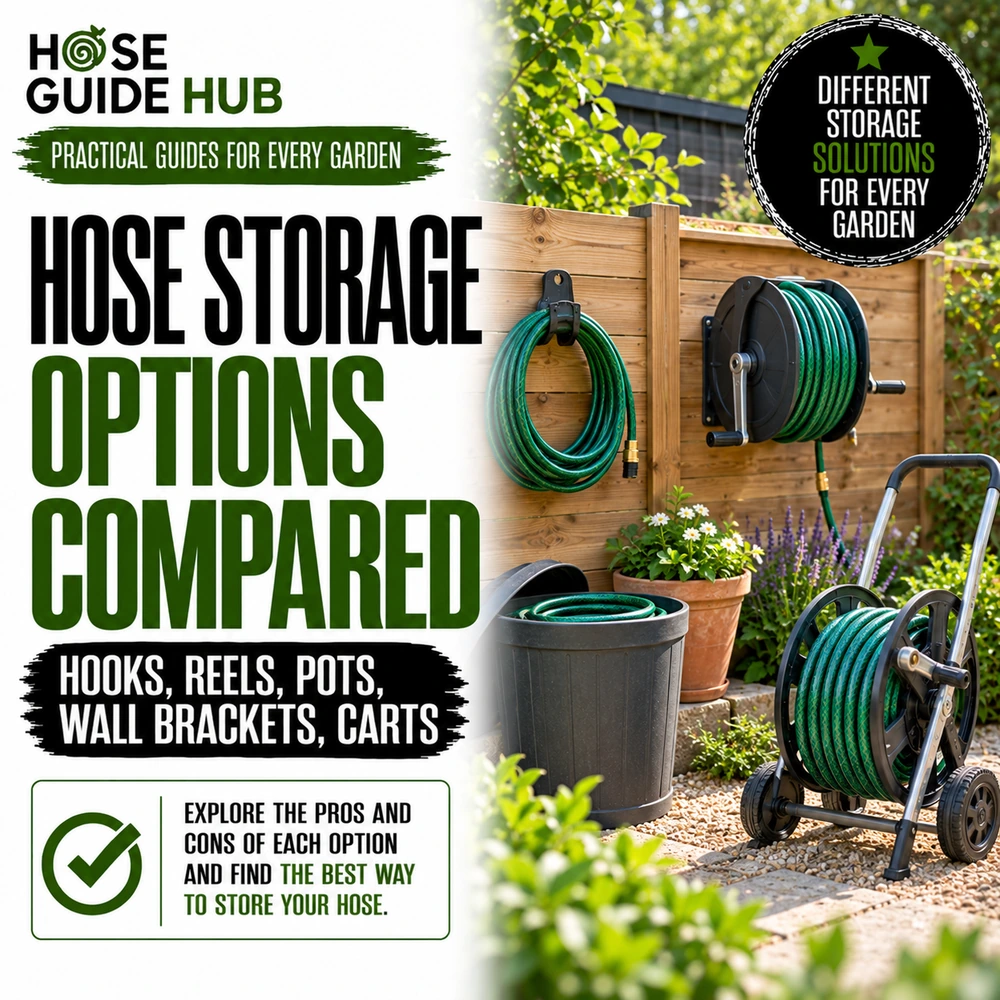
Hose Storage Options Compared: Hooks, Reels, Pots, Wall Brackets, Carts
A hose left coiled in a heap by the spigot doesn’t just look sloppy. It kinks at the same three spots every time, bakes under UV light until the outer jacket goes brittle, and gives mice a place to nest over winter. Figuring out how to store garden hose properly is less about tidiness and more about protecting something you use every week from April through October. The method you choose also decides how much fighting you do with tangles before you can water a single tomato plant. Five approaches cover almost every yard: hooks, reels, pots, wall brackets, and carts. Each one suits a different combination of hose length, wall access, and how much installation work you’re willing to do.
Disclosure: As an Amazon Associate, we earn from qualifying purchases made through links on this site. Learn more.
Quick Answer
Hooks handle up to 50 feet of hose with the least setup. Wall mounted crank reels hold 75 to 100 feet, freestanding reels hold 100 to 150 feet, and auto rewind reels hold 50 to 100 feet inside an enclosed housing. Hose pots hide up to 75 feet of coiled hose out of sight, wall brackets manage up to 75 feet while also covering the spigot, and hose carts handle the most volume at 100 to 200 feet or more on wheels. Pick based on how much hose you’re storing, whether you can drill into a wall, and how far you move the hose from spigot to garden bed.
Why Does Hose Storage Actually Matter?
A hose that spends its life on the ground degrades fast no matter how good the rubber or vinyl compound is. A few things happen when storage gets skipped.
- Direct sun breaks down the plasticizers in vinyl hoses, and within two or three seasons the jacket turns stiff and starts cracking near the fittings.
- A hose coiled tightly around a single point, or left in loose loops on the ground, develops kinks that eventually crease and split at the same spot.
- Standing water left inside a hose through a hard freeze can split the wall from the inside. You won’t see the damage until you turn the water back on in spring.
- A hose crossing a path or driveway is one of the more common tripping hazards in a yard, right up there with a rake left tines up.
- Coiled hoses left undisturbed near a foundation or shed make an appealing winter nest site for mice and voles.
None of this calls for an elaborate setup. It just means the five approaches below solve slightly different problems, and picking the wrong one for your situation is a big part of why so many hoses get replaced every couple of years instead of lasting closer to a decade. So let’s go into how to store garden hose.
The Options at a Glance
Before getting into installation details, here’s how the main types stack up on capacity, mounting, and how much protection they actually give the hose.
| Storage type | Typical capacity | Mounting | Weather protection | Setup effort |
| Hose hook | Up to 50 ft | Wall or fence post | Minimal unless paired with a cover | Very low |
| Wall mounted crank reel | 75 to 100 ft | Wall near the hose bib | Partial, hose stays exposed | Low to moderate |
| Freestanding reel | 100 to 150 ft | Ground, portable | Partial | Low |
| Auto rewind reel | 50 to 100 ft | Wall or boxed unit | Good when the housing is enclosed | Moderate |
| Hose pot | Up to 75 ft coiled | Ground, near the bib | Good, hose sits hidden inside | Low |
| Wall bracket | Up to 75 ft | Wall, usually over the bib | Partial | Moderate |
| Hose cart | 100 to 200+ ft | Ground, wheeled, portable | Varies by model | Low to moderate |
Wall Mounted Hose Hooks
A hook is the simplest option on this list, and for a lot of yards it’s also the right one. No moving parts, nothing to wire up, nothing that needs winterizing beyond disconnecting the hose itself.
How They Work
A single or double arm bracket screws into a wall, fence, or post, and you loop the hose over it in loose coils, largest loop first so the weight doesn’t pull against the fitting. Hooks come in plastic, cast iron, and stainless steel, and the metal versions hold up noticeably better outdoors since plastic gets brittle under the same UV exposure that damages the hose itself.
Where to Mount One
Mount it close enough to the spigot that you’re not dragging a full hose length sideways before hanging it, but high enough that the bottom of the coil clears the ground by a few inches. Anchor into a stud or masonry rather than drywall alone. A loaded hook holding 100 feet of water filled hose is heavier than it looks, easily 30 to 40 pounds, and a screw sunk into hollow drywall will eventually pull loose.
The Kinking Problem and How to Avoid It
A basic single point hook forces every loop to bend around the same small radius, which is exactly how kinks start. A hook with a wider curved arm, or one shaped for a figure eight wrap, spreads that bend across a much larger area and adds years to the hose’s life. If you’re stuck with a narrow hook, coil loosely rather than cinching the loops tight.
Hose Reels: Wall Mounted, Freestanding, and Auto Rewind
Reels solve the tangling problem that hooks don’t. Instead of stacking loose coils, the hose winds evenly around a drum, which also makes it faster to pay out and pull back in. Three variations cover most needs.
Wall Mounted Crank Reels
These bolt to a wall near the spigot and use a hand crank to wind the hose back onto the drum after use. They hold more hose than a typical hook setup and keep the coils uniform, which matters if you’re storing a longer hose that would otherwise sag under its own weight. The trade-off is that the hose itself usually still sits exposed to weather unless the reel includes a cover.
Freestanding Reels
A freestanding reel sits on its own base or small set of wheels rather than bolting to anything, which makes it a better fit for a rental property or anywhere you can’t drill into siding. You can reposition it near whichever spigot you’re using, though most models still work best staying in one general spot since they’re not built for repeated hauling across the yard.
Auto Rewind Reels
These use a spring loaded mechanism inside a housing, so pulling the hose out builds tension that reels it back in automatically once you release it. They’re the fastest option to use day to day and often come in a fully enclosed box that shields the hose from sun and rain. The mechanism is also the part most likely to eventually wear out, and repairing a broken spring assembly is usually not worth the trouble compared to just replacing the unit.
Decorative Hose Pots
A hose pot looks like a large planter or urn, with an opening near the base where the hose feeds through. You coil the hose inside and it stays out of sight entirely, which is the main draw for anyone who wants their hose storage to look like a garden feature rather than hardware.
What to Look for in a Pot
Size the pot to your hose length so you’re not forcing 100 feet of hose into a container meant for 50. Resin and faux clay pots weigh less and resist cracking better than real ceramic if you’re anywhere that sees a hard freeze. Check that the side opening is smooth edged, since a rough or sharp cutout will wear through the hose jacket exactly where it rubs with every use.
The Drainage Detail People Miss
A pot with no drainage hole fills with rainwater around the coiled hose, and that trapped moisture does two things: it encourages mold on the hose exterior, and in freezing climates the water expands and can crack the pot itself. A drainage hole at the base, or a slightly raised inner platform, keeps the hose out of standing water without you having to think about it.
Wall Brackets With Hose Bib Covers
A wall bracket looks similar to a hook at first glance but usually comes as a larger unit that mounts directly over the hose bib, often with a small door or faceplate that hides the spigot itself along with the coiled hose.
How Brackets Differ From Hooks
The main difference is coverage. A hook is just a hanging point, while a bracket typically includes a backing plate, sometimes a small shelf for nozzles and fittings, and a housing that blocks direct sun on at least part of the coil. That added structure means more screws and a slightly more involved install, usually into masonry near a foundation spigot.
Good Candidates for Brackets
Brackets make the most sense right where a hose connects to the house, since covering the bib itself has the side benefit of a little extra winter insulation in colder climates. If your spigot sits on a visible wall near a patio or front entrance, a bracket also does more to disguise the whole setup than a plain hook would.
Hose Carts
A cart is a reel mounted on wheels, built to move around the yard rather than stay fixed in one spot. It’s the option built for scale, both in hose length and in distance covered.
When a Cart Earns Its Space
If your property has multiple spigots, several garden beds spread across a larger lot, or you’re regularly running a hose 150 feet or more, a cart saves a lot of walking back and forth. You wheel the whole setup to wherever you’re watering instead of dragging a hose from a fixed reel across the entire yard.
Wheels and Terrain
Wheel size matters more than most buyers expect. Small hard plastic wheels work fine on a driveway or patio but bog down fast on grass, mulch, or gravel. Larger pneumatic or wide plastic wheels handle uneven ground far better, so it’s worth matching the wheel type to your actual yard surface rather than picking based on looks.
How Do You Match Storage to Your Yard?
The right pick usually comes down to four questions: how much hose you’re storing, whether you can drill into a wall, how much the setup needs to look tidy versus just work, and how far you’re regularly moving the hose from spigot to garden bed.
| Your situation | Best fit |
| Small patio or balcony with a single short hose | Compact hook or a slim wall bracket, since neither eats up floor space |
| Average suburban yard with one main spigot | Wall mounted reel or a hose pot, depending on whether you want the hose visible or hidden |
| Rental property with no drilling allowed | Freestanding reel or a hose cart, since neither requires anchoring into siding or brick |
| Large property with multiple watering zones | Hose cart, or several fixed reels near each spigot if the hose rarely travels far |
| A yard where curb appeal matters, like a front entrance | Hose pot or a bracket with a bib cover, since both hide the working parts |
What Mistakes Shorten Hose Life?
A handful of habits do more damage than the storage method itself.
- Coiling a hose the wrong direction against its natural twist, which fights the internal reinforcement and speeds up kinking.
- Leaving a hose connected and pressurized at the spigot between uses, which keeps constant strain on the fitting.
- Storing a hose in full sun with no cover through the hottest months, even briefly, adds up over a season.
- Dragging a hose across pavement or gravel instead of lifting it, which wears through the outer jacket faster than any amount of UV exposure.
- Skipping the fall drain and disconnect in freezing climates, which is the single most common cause of a hose splitting outright.
Frequently Asked Questions
How much hose can a wall mounted crank reel hold?
Most wall mounted crank reels hold 75 to 100 feet of hose, more than a typical hook but less than a freestanding reel or cart.
Does a hose pot need a drainage hole?
Yes. Without one, rainwater collects around the coiled hose, which encourages mold and can crack the pot itself if the trapped water freezes and expands.
How much weight does a loaded hose hook need to support?
A hook loaded with 100 feet of water filled hose can weigh 30 to 40 pounds, so it should be anchored into a stud or masonry rather than drywall alone.
What’s the best hose storage option for a rental property?
A freestanding reel or a hose cart, since neither requires drilling into siding or brick.
How much hose can a hose cart hold?
Hose carts typically handle 100 to 200 feet or more, the highest capacity of the five storage types covered here.
What Does a Simple Seasonal Storage Routine Look Like?
Whatever method you land on, a few habits make it last.
Spring: check fittings for cracks or stripped threads before the first real use of the season, and replace washers that dried out over winter.
Summer: coil loosely and keep the hose out of direct afternoon sun when it’s not in use, even if that just means draping it in shade rather than leaving it stretched across a sunny lawn.
Fall: drain the hose completely, disconnect it from the spigot, and shut off any indoor valve feeding an outdoor bib if your house has one, before the first hard frost.
Winter: store indoors, in a garage, or in an insulated hose pot if you’re in a climate that freezes. A hose left connected to an unprotected outdoor spigot over winter risks damage to the spigot itself, not just the hose.
A basic hook paired with consistent care will often outlast an expensive hose that spent every winter frozen to the ground. The storage method matters less than actually using it, whichever one you pick.