
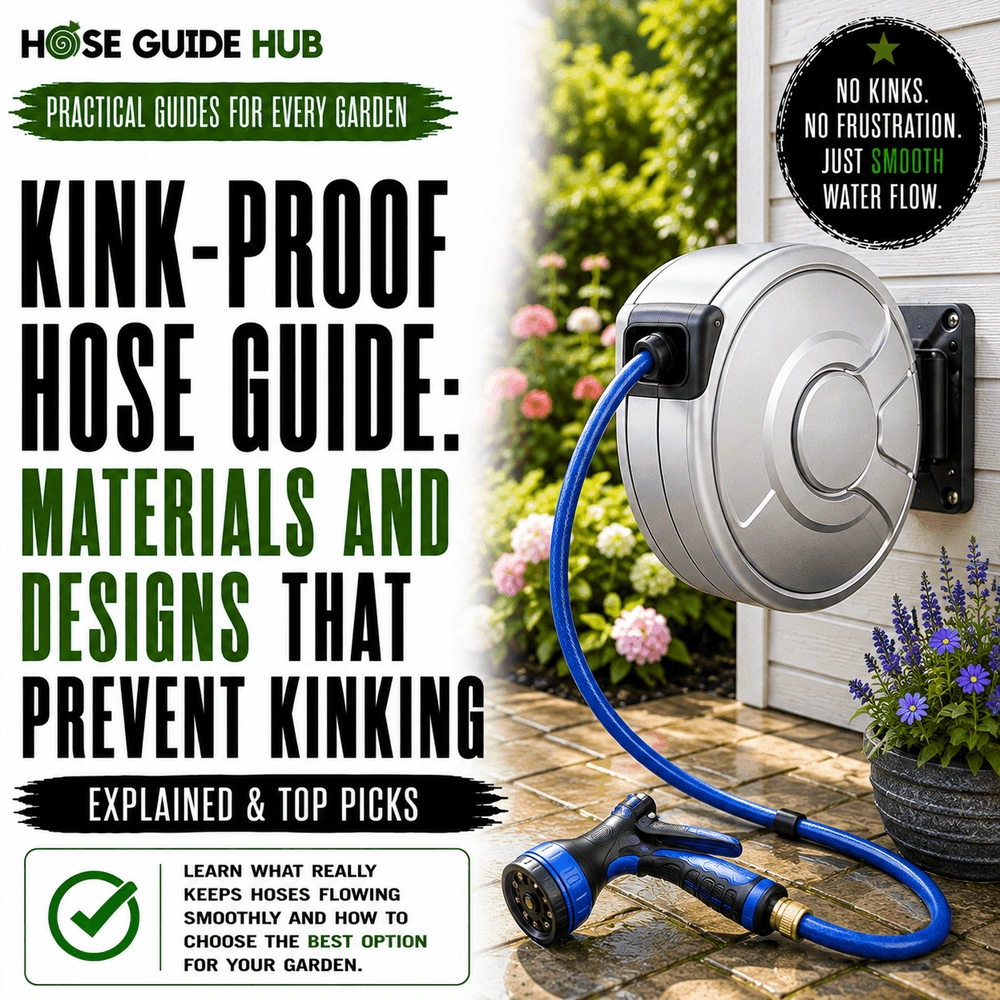
Kink-Proof Hose Guide: Materials And Designs That Prevent Kinking Explained & Top Picks
If you’ve spent any July evening wrestling a hose that’s folded itself into a pretzel three feet from the spigot, you already know the fix isn’t a fancier nozzle. It’s a garden hose kink free by design, built from the reel outward so the hose never gets the chance to twist, crimp, or fold on itself in the first place. Kinking isn’t bad luck. It’s physics, and once you understand which materials and mechanisms actually prevent it, picking the right retractable reel gets a lot easier.
This guide breaks down exactly what causes hoses to kink, which design features genuinely stop it, and then walks through three retractable hose reels that were built with kink prevention as the whole point, not an afterthought.
Disclosure: As an Amazon Associate, we earn from qualifying purchases made through links on this site. Learn more.
What Actually Causes a Garden Hose to Kink?
A hose kinks when a bend tightens past the point its wall can hold open, and nothing around it is stopping the fold from locking in place. Three things push a hose toward that point.
Wall Thickness and Hose Material
Thin-walled PVC hose collapses under a sharp bend the same way a drinking straw does. Thicker PVC walls, or hose blends that mix in rubber or polyurethane, resist that collapse because there’s more material fighting to hold the tube round. Hose diameter matters too. A 5/8 inch hose is stiffer and more kink-resistant than a 1/2 inch hose of the same wall thickness, though it also weighs more on the reel and needs a stronger spring to retract it.
Uneven Winding on the Drum
Most kinks that show up over months of use don’t happen while you’re watering. They happen during rewind, when the hose stacks unevenly on the drum, crosses over itself, and gets pinched between wraps. A reel without a mechanism to guide the hose back in a level, even layer will eventually jam a loop under itself, and that crossover point becomes a permanent weak spot.
Twisting Force From Off-Angle Pulls
Pull a hose sideways from a fixed reel and you’re not just stretching it, you’re twisting it against the mount. That torque works into the hose wall over time and shows up later as a kink in a spot that was never bent by hand. This is why the angle of the wall bracket matters as much as the hose itself.
Four Design Features That Actually Stop Kinking
Manufacturers have landed on a handful of mechanisms that address each of the causes above,making a garden hose kink free (as much as possible). Here’s what to look for.
Self-Aligning Guide Arms
A guide arm sits at the point where the hose feeds onto the drum and shifts side to side as the hose retracts, laying each wrap next to the last one instead of on top of it. This is the single feature that prevents the crossover kinks described above, and every reel in this guide uses some version of it.
180-Degree Swivel Brackets
A bracket that pivots the entire reel body 180 degrees lets you pull the hose out at whatever angle the task requires without twisting the hose against a fixed mount. This is what keeps a reel useful for a yard, a driveway, and a side gate all from one mounting point.
Any-Length Locking
A locking mechanism that holds the hose at whatever length you’ve pulled out means you’re not dragging slack hose across concrete or gravel, which is one of the fastest ways to abrade and eventually crease a hose wall. Lock it at 30 feet for the flower bed, lock it at 90 for the far corner of the lawn.
Controlled, Slow-Speed Rewind
A hose that snaps back at full speed slaps against the casing edge and can fold sharply right at the entry point. A slow, spring-damped rewind lets the guide arm do its job properly and avoids that whip-back crease.
Three Retractable Reels Built Around Kink Prevention
With those four mechanisms in mind, here’s how three current retractable reels stack up. All three are wall-mounted, all three include a spray nozzle, and all three are built around the same core idea: an evenly guided, slow-rewinding hose beats a hose reel with no guide system every time.
Patoolio H21
View Product: Patoolio H21
The Patoolio H21 is built for reach first. It carries a 100 foot hose plus a 6.6 foot leader hose, giving 106.6 feet of usable coverage from a single wall mount, which is enough to cover most standard suburban lots without repositioning. The hose itself is 1/2 inch thickened PVC rated to 150 PSI working pressure and 600 PSI burst pressure, so it holds its shape under normal residential water pressure without ballooning or going soft.
Its rewind system is described by Patoolio as a slow-rebound design, meaning the hose doesn’t snap back hard against the casing, which protects both the hose wall and anyone standing nearby. The reel locks at any length, includes a 10-pattern spray nozzle, and mounts on a 180 degree swivel bracket. The housing is a compact 22.38 x 8.85 x 16.17 inches, making it one of the smaller footprints in this comparison for a reel carrying over 100 feet of hose.
Hoselink Classic Charcoal 82ft Hi-Flow (US3325-CH)
View Product: HOSELINK US3325-CH-Parent
Hoselink’s Classic series is built around a wider 9/16 inch Hi-Flow hose rather than the more common 1/2 inch, which pushes more water through at the same pressure and holds its shape better on tight bends. The 82ft version reviewed here comes with a 6.5 foot leader hose connecting to your tap, and Hoselink’s own engineering notes describe the hose compound as intentionally soft and pliable so it can flex through the retraction mechanism without twisting, which the brand identifies as the leading cause of kinks in reels without that flex.
The rewind system uses a spring-loaded guide that Hoselink says lays the hose evenly across the drum with no jamming or overlap, and the whole unit is rated for more than 1,300 retraction cycles. A stop-anywhere locking mechanism holds the hose at any pulled length. The casing is UV-stabilized polypropylene built to handle direct summer sun without becoming brittle, and the hose itself is BPA-free, PFAS-free, and lead-free. The reel ships with a mounting bracket, four bolts, an 8-pattern spray nozzle, and Hoselink’s quick-connect fittings, which include a swivel at the nozzle end so the accessory can rotate without twisting the hose. Housing dimensions run 24 x 10.6 x 19.3 inches, and the unit carries a 2-year warranty. Hoselink also sells 50ft and 100ft versions on the same universal bracket, so the mount you install now works if you upgrade the reel later.
PQH ZYW019-S30
View Product: PQH ZYW019-S30
The PQH ZYW019-S30 leads with its self-aligning guide system, which the listing describes as ensuring the hose retracts evenly every time, specifically to prevent tangles, kinks, and jams. It pairs that with a controlled rewind that takes 10 to 12 seconds to fully retract 100 feet of hose, noticeably slower and more even than a reel that snaps back in two or three seconds, which keeps the hose from whipping against the housing on the last few feet.
The hose is 1/2 inch PVC rated to 120 PSI working pressure, and the reel’s 180 degree swivel bracket is rated by the manufacturer to cover yards up to 10,000 square feet without moving the mount. It locks at any length and includes a 10-pattern nozzle. The housing measures 19.09 x 9.84 x 19.09 inches, and the polypropylene casing is molded in green and black. PQH also sells 66ft, a 100ft version in 5/8 inch, and a 150ft version of the same reel body if you need more or less hose than this 100ft 1/2 inch configuration.
Side-by-Side Comparison
| Feature | Patoolio H21 | Hoselink Classic Charcoal 82ft | PQH ZYW019-S30 |
| Hose length | 100 ft + 6.6 ft leader (106.6 ft total) | 82 ft + 6.5 ft leader | 100 ft + 6.6 ft leader |
| Hose diameter | 1/2 in | 9/16 in Hi-Flow | 1/2 in |
| Hose material | Thickened PVC | PVC (BPA, PFAS, lead free) | PVC |
| Working pressure | 150 PSI | Not specified by brand | 120 PSI |
| Burst pressure | 600 PSI | Not specified by brand | Not specified by brand |
| Guide system | Slow-rebound auto guide | Even-layer spring guide | Self-aligning guide |
| Swivel bracket | 180 degrees | 180 degrees | 180 degrees (rated to 10,000 sq ft) |
| Length lock | Yes, any length | Yes, stop-anywhere | Yes, any length |
| Spray nozzle | 10-pattern | 8-pattern | 10-pattern |
| Casing material | Plastic | UV-stabilized polypropylene | Polypropylene |
| Reel dimensions (L x W x H) | 22.38 x 8.85 x 16.17 in | 24 x 10.6 x 19.3 in | 19.09 x 9.84 x 19.09 in |
| Warranty | Not specified by brand | 2 years | Not specified by brand |
Which One Fits Your Yard
For a mid-size yard where water pressure at the tap is already decent, the Patoolio H21 or the PQH ZYW019-S30 both cover the same practical ground, right around 100 to 107 feet with a 1/2 inch hose. The Patoolio has the higher rated burst pressure on paper, useful if your home runs hotter water pressure than average. The PQH leans on its 10 to 12 second rewind timing and a bracket rated for larger properties.
If your home has weaker water pressure, or you’re regularly running the hose at distance for a sprinkler or pressure-sensitive attachment, the Hoselink’s wider 9/16 inch Hi-Flow hose is the one built to compensate. It’s also the only one of the three with a published retraction-cycle rating and a stated warranty, which matters if you’re mounting this to a wall you don’t want to revisit for hardware failures.
Smaller patios or townhome-sized yards don’t need 100-plus feet of hose at all. All three brands sell shorter versions of the same reel body on the same style of bracket, so the guide-arm and swivel mechanics described above carry over even if you go with a 50 or 66 foot option instead.
Installation and Care Tips That Keep Any Garden Hose Kink Free For Years
The mechanism only works if it’s installed and used correctly.
- Mount the bracket at a height where the hose feeds out roughly level with the guide arm, not sharply up or down, so the arm doesn’t have to fight gravity to lay each wrap straight.
- Let the reel do the rewinding. Feeding the hose back in by hand instead of letting the spring and guide arm work together is the fastest way to create the exact overlap the guide arm exists to prevent.
- Don’t yank the hose at a hard sideways angle from a fixed, non-swivel point. If your bracket swivels, let it swivel with you instead of forcing the hose to twist against it.
- In freezing climates, drain the hose before winter and check that the housing is rated for cold. A hose that’s gone stiff from cold and then gets forced around the drum is far more likely to crease permanently.
- Wipe grit off the hose before it retracts. Sand and dirt ground into the guide arm’s channel is a common reason a previously smooth-rewinding reel starts stacking unevenly after a season or two.
Frequently Asked Questions
Does hose diameter really change how much it kinks?
Yes. A wider hose wall has more material resisting collapse at a bend, which is why Hi-Flow style 9/16 inch hoses tend to hold their shape better than standard 1/2 inch hose under the same bending force.
Is a retractable reel actually less prone to kinking than a coiled hose on the ground?
In most cases, yes, because the guide arm controls how the hose winds instead of leaving it to fold randomly on the ground, and the swivel bracket removes the twisting force that builds up when you drag a ground-coiled hose around a corner.
Do these reels work with a spray nozzle or sprinkler I already own?
All three include their own nozzle, and the quick-connect fittings on each are standard hose-thread compatible, so existing sprinklers, wands, and attachments will thread on without issue.
A hose that stays kink-free for years comes down to the same three things every time: a wall thick enough to resist collapsing, a guide system that stops it from crossing over itself on the reel, and a bracket that lets it move with you instead of against you. Match those three to your yard size and water pressure, and the hose problem mostly disappears on its own.