
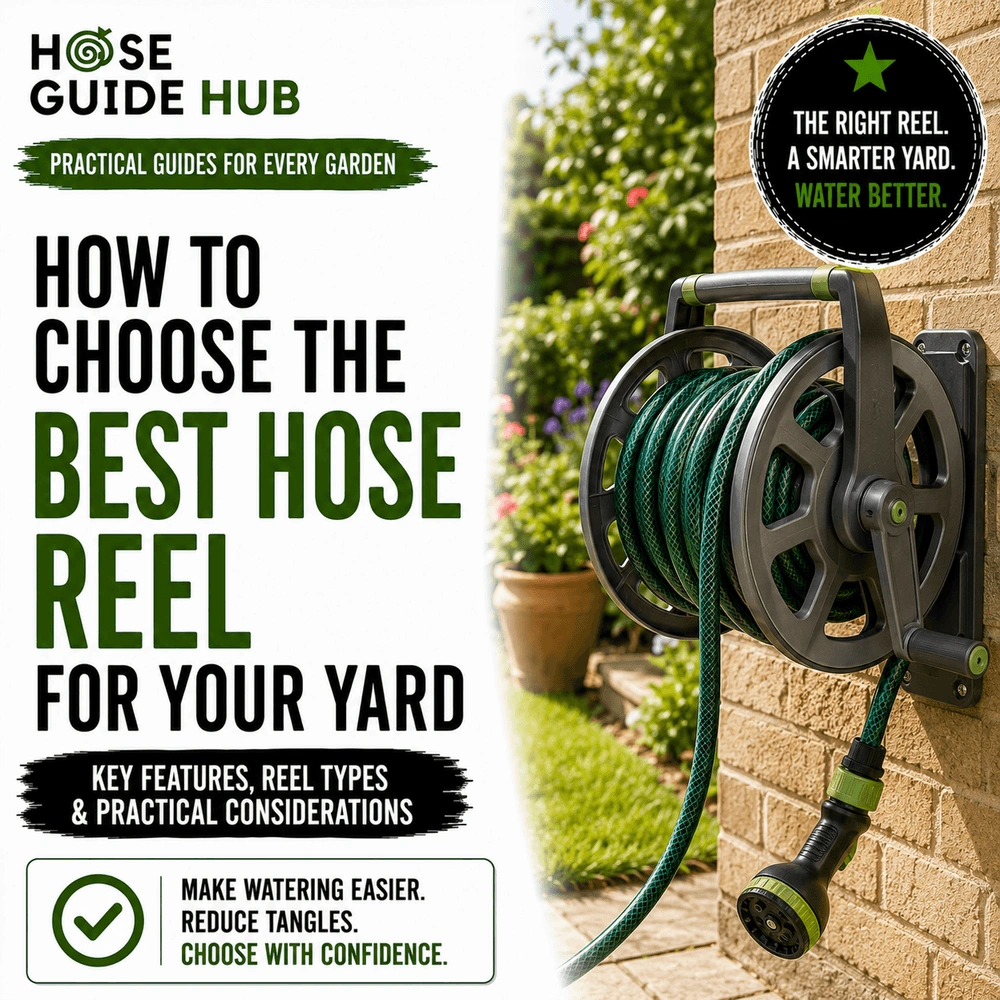
How To Choose The Best Hose Reel For Your Yard
Knowing how to choose the best hose reel for your yard comes down to a handful of decisions: where you’ll mount it, how much hose you actually need, what material will survive your climate, and whether the convenience of an auto-retract system is worth the extra spend. Get those four things right and you’re done. Get them wrong and you’ll be replacing a reel in two seasons.
This guide covers every meaningful factor, with comparison tables, specific numbers, and trade-offs so you can make the call for your yard, not someone else’s.
Disclosure: As an Amazon Associate, we earn from qualifying purchases made through links on this site. Learn more.
How Much Hose Length Do You Actually Need?
The single most common buying mistake is underestimating length. People measure the distance from the faucet to the far end of their yard in a straight line, then buy that exact length, and discover the hose can’t reach around the corner of the house or along the fence line.
Add 20 to 30 percent to your straight-line measurement to account for routing around obstacles. And factor in that longer hoses do lose flow rate: a 5/8-inch hose at 50 PSI delivers roughly 25 gallons per minute at 50 feet, dropping to around 12.5 gallons per minute at 100 feet. If you need strong flow at the end of a long hose, consider upgrading from a 5/8-inch to a 3/4-inch diameter.
| Yard Size | Recommended Length | Notes | Hose Diameter |
| Small patio / balcony | 25 – 50 ft | Compact reel sufficient | 1/2 inch |
| Average suburban yard | 50 – 75 ft | Most common setup | 5/8 inch |
| Large yard / garden | 75 – 100 ft | Consider cart or retractable | 5/8 inch |
| Acreage / estate | 100 – 150 ft+ | Heavy-duty cart recommended | 5/8 or 3/4 inch |
One practical tip: measure from your faucet to the furthest point you need to water, walk the route you’d actually take (around beds, along the fence), and add a 15-foot buffer. That’s your number.
Hose Diameter and Water Flow: The Numbers Matter
Hose diameter directly controls water flow. The three standard sizes are 1/2 inch, 5/8 inch, and 3/4 inch.
- 1/2-inch hose: Lightweight and easy to handle. Works well for small gardens, flower beds, or potted plants on a patio. Lower flow rate means less pressure at the nozzle.
- 5/8-inch hose: The standard for most residential yards. Delivers a solid balance of flow rate and manageability. This is what the majority of retractable reels are designed around.
- 3/4-inch hose: Best for large lawns, filling containers fast, or running sprinklers. More water per minute, but heavier on the reel and harder to maneuver.
One caveat when buying retractable reels: some models use a 1/2-inch internal hose even though the fittings accept a 5/8-inch connection. That narrower hose reduces your actual flow rate. Check the internal diameter in the product specs, not just the fitting size.
Material Guide: What Will Actually Last in Your Climate
This is where cheap reels fall apart, sometimes literally. UV exposure, freeze-thaw cycles, and coastal salt air all attack reel materials in different ways.
| Material | Durability | Rust Resistance | Weight | Cost |
| ABS/PP Plastic | Moderate (brittle in UV over time) | Excellent | Light | Low |
| Resin | Good, UV weakens slowly | Excellent | Light-medium | Low-mid |
| Powder-Coated Steel | Very good | Good (coating must stay intact) | Heavy | Mid |
| Aluminum Alloy | Excellent | Excellent | Medium | Mid-high |
| Stainless Steel | Outstanding | Outstanding | Heavy | High |
Plastic (ABS / Polypropylene)
Fine for moderate climates and occasional use. UV exposure causes polypropylene and ABS to become brittle over time. In climates with intense sun, particularly the southern US, Florida, or Texas, a plastic reel may crack within two to three seasons. Look for models advertised as UV-stabilized.
Resin
Resin is the material used in most hideaway reels. It’s lightweight, rust-proof, and holds up reasonably well in all weather. It will gradually weaken under prolonged direct sun, but the degradation is slower than basic plastic.
Powder-Coated Steel
More durable than plastic and cheaper than aluminum. The powder coating is the weak point: if it chips, moisture gets to the steel underneath and rust starts quickly. Inspect fittings and edges when you buy, and avoid dragging it across concrete.
Aluminum Alloy
The sweet spot for most serious gardeners. Lightweight relative to steel, naturally rust-resistant, and structurally stable. Eley Hose Reels, a well-regarded US manufacturer, uses an aluminum alloy blended with iron, copper, magnesium, silicon, and zinc, producing a frame that’s stronger than pure aluminum while staying genuinely rust-proof.
Stainless Steel
The choice for coastal properties, high-humidity climates, or anyone who wants to buy once and never again. Expect to pay a premium, but stainless steel stands up to salt air and tropical rain with no maintenance beyond rinsing.
Whatever the reel body is made of, check the fittings separately. Brass fittings outperform plastic ones in every measure: they don’t crack under hose tension, they don’t leak, and they tolerate high water pressure. If a reel ships with plastic fittings, budget for replacing them with brass.
Retractable vs Manual: Which System Is Right for You?
Automatic retraction is convenient. You release a latch, the spring pulls the hose in. Done in seconds. But ‘automatic’ doesn’t mean ‘better for everyone.’
Choose a retractable reel if:
- You water daily and hose management is the most tedious part of the task
- You have kids or pets who might trip over a hose left out
- You want the hose fully protected inside its housing when stored
- You don’t mind spending $80 to $300 for a quality model
Choose a manual reel if:
- Budget is a primary concern (solid manual reels start around $30)
- You prefer mechanical simplicity with fewer parts that can fail
- You water less frequently and don’t mind a few cranks to wind up
- You want a large capacity reel without the retractable price premium
One thing to know about retractable systems: spring quality varies enormously. Good springs, like the steel springs in Giraffe Tools and Hoselink models, are rated for 20,000 or more retractions. Budget models use weaker springs that lose tension within a season or two and stop fully retracting the hose.
Wall-Mount vs Portable: The Setup Question
This decision is largely about yard size and lifestyle.
A wall-mounted reel is the right call when you have one main watering area, or when your faucet is centrally positioned relative to everything you water. Once it’s mounted, it takes up no floor space, stays anchored during use, and the hose can reach around the yard on a swivel bracket. The limitation is obvious: it doesn’t move.
A portable cart solves the multi-zone problem. Large properties, vegetable patches far from the house, front and back yard watering from the same unit, or situations where the water spigot is in a suboptimal location. Carts with pneumatic tires handle uneven terrain much better than flat-wheeled models.
The one thing wall-mount reels offer that carts can’t: stability under pressure. A fixed wall bracket won’t tip or drag when you’re pulling a full 100 feet of hose.
Key Features to Check Before Buying
Swivel Range
A 180-degree swivel bracket on a wall-mounted reel dramatically expands coverage. Without swivel, you’re anchored to one direction. Most quality retractable reels offer close to 180 degrees.
Leader Hose Length
The leader hose connects the reel to your faucet. Longer leaders let you mount the reel higher or further from the water source. A 6-foot leader is standard; some models include 8 to 10 feet.
Hose Stop Mechanism
This prevents the hose from fully retracting into the reel and disappearing. It sounds minor until you’re hunting for the end of your hose inside a sealed housing. A rubber hose stop or a good end fitting solves this.
Nozzle Spray Patterns
Many reels come bundled with a multi-pattern nozzle, typically offering 7 to 10 settings: jet, flat, mist, shower, cone, and so on. If the included nozzle is cheap plastic, replace it with a brass model. The difference in longevity is significant.
Pressure Rating
US residential water pressure typically runs between 35 and 65 PSI. A reel rated to 150 PSI handles this easily. If you’re connecting to a boosted irrigation system, check that both the reel and hose are rated accordingly. Some retractable hoses are tested to 200 PSI working pressure and 600 PSI burst pressure, which provides a comfortable safety margin.
Quick Decision Guide: Match Your Situation to the Right Reel
Not sure which type fits your setup? Use this reference.
| Your Situation | Best Pick | Why |
| Small yard, tight budget | Wall-mount manual | Cheap, reliable, easy to install |
| Mid-size yard, daily watering | Wall-mount retractable | Speed and convenience justify the cost |
| Large yard, multiple zones | Hose reel cart | Mobility lets you move the water source with you |
| Curb appeal matters most | Hideaway / cabinet reel | Hose stays hidden when not in use |
| Renting, cannot drill walls | Ground-mounted or cart | No permanent fixtures required |
| Coastal or harsh climate | Aluminum or stainless steel | Resists salt air and UV without corroding |
What to Avoid When Shopping
A few red flags that often signal a reel will fail prematurely:
- Plastic fittings throughout: They crack under repeated tightening and are the first thing to leak. Brass fittings at minimum on the connections that matter.
- No slow-return mechanism: Fast-retracting spring systems snap the hose back sharply, wearing fittings and occasionally becoming a hazard. Check product listings for ‘slow return’ or ‘controlled rewind.’
- No UV rating on plastic bodies: Generic ABS with no UV stabilization will crack in direct sun within a couple of seasons. This kills a lot of budget reels.
- No rotation on wall mount: A fixed-position wall mount with no swivel is almost useless for anything beyond a very narrow watering corridor.
- Vague hose capacity claims: Hose capacity changes significantly by diameter. A reel claiming ‘100 feet’ without specifying hose diameter may be rated for a thin 1/2-inch hose and won’t accept 100 feet of standard 5/8-inch hose.
Installation: What to Know Before You Mount
Wall-mount reels require a solid substrate. Vinyl siding alone won’t hold the bracket under the weight and tension of a full hose. Mount into a stud, a concrete block, or a timber fence post. Most reel kits include self-tapping screws that work for timber but not masonry: pick up appropriate masonry anchors if you’re mounting to brick or concrete.
Ground-mount and spike reels are installed by pushing the spike into the lawn. They’re stable in soft soil but can wobble in sandy or hard-packed ground. Watering before installation softens the soil and makes placement easier.
For hose reel carts, assembly usually takes 20 to 30 minutes. The main connection to verify is the inlet fitting: make sure it creates a watertight seal before loading the reel with hose.
Maintenance Tips That Extend Reel Life
- Drain the hose before winter. Water left sitting in a hose during freeze conditions can split the hose and damage internal reel components.
- For retractable reels stored outside, remove the housing or cover it through winter. Most retractable units are designed to detach from their bracket for off-season indoor storage.
- Keep the swivel joint clean. A small amount of silicone spray on the swivel mechanism prevents stiffening and extends smooth rotation.
- Inspect the leader hose and fittings annually. This short section takes more wear than the rest of the hose because it’s repeatedly connected and disconnected at the faucet.
- If a retractable reel stops retracting fully, the spring has usually lost tension. Some models allow spring replacement; others are sealed units. Check serviceability before buying if longevity is a priority.
To Summarize
Choosing a hose reel is genuinely simpler than the options make it look. Figure out where you’ll put it (wall, ground, or rolling it around), how much hose you need (measure the route, add 20 percent), what your climate demands from the materials, and whether auto-retract is worth the cost for your frequency of use.
Spend appropriately on fittings. A brass fitting on a mid-range reel will outlast a plastic fitting on a premium one. And if you live somewhere with punishing sun, salt air, or hard winters, pay for aluminum or stainless steel. You’ll buy once and spend the next decade not thinking about your hose.
See best retractable garden hose reel guide.