
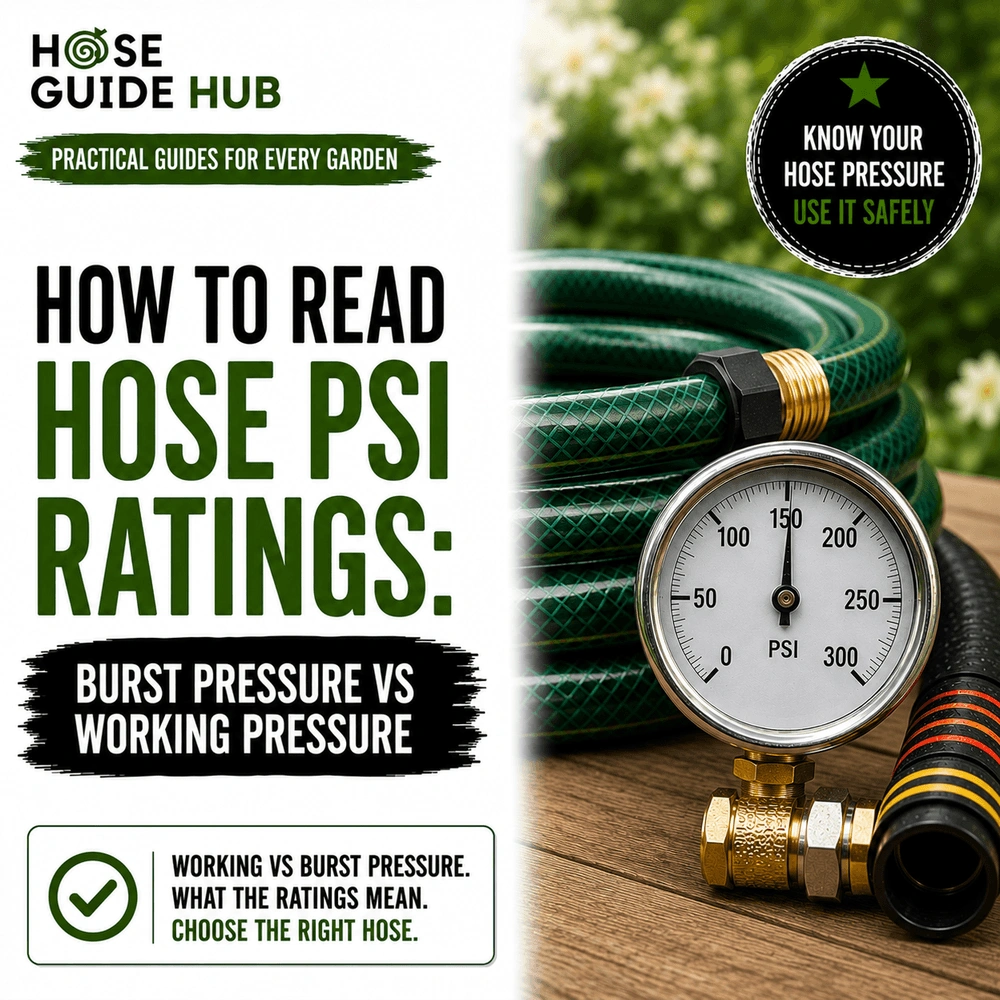
How to Read Hose PSI Ratings: Burst Pressure vs Working Pressure, Safety Tips
Grab any decent garden hose off a shelf and flip it over. Somewhere on the tag, or stamped right into the rubber itself, there’s a PSI number, sometimes two of them sitting side by side. Most people never look twice. They hook the hose to the spigot, blast the driveway, coil it back up, and forget it exists until next spring. That’s fine right up until the day a fitting blows off mid-spray and soaks the side of the house. This garden hose psi rating explained guide breaks down what those numbers on the tag actually mean, why quality hoses list two separate figures instead of one, and how to use that information so you’re not the person standing there wondering why a two-week-old hose just split open.
Disclosure: As an Amazon Associate, we earn from qualifying purchases made through links on this site. Learn more.
What “PSI” Actually Means on a Hose Tag: Garden Hose PSI Rating Explained
PSI stands for pounds per square inch. It’s a measure of pressure, not volume, so it has nothing to do with how much water comes out the end of the hose. A hose’s PSI rating tells you how much internal pressure the hose wall can take before something goes wrong, either “wrong” in the sense of dangerous failure, or “wrong” in the sense of the hose simply not being built for that kind of daily strain.
Cheap hoses sometimes skip printing a PSI number entirely. That’s not an oversight. It usually means the manufacturer didn’t test to a specific standard, or didn’t want to commit to a number they’d have to stand behind. If you can’t find a PSI rating anywhere on the hose, the packaging, or the tag, treat that hose as unrated and don’t push it past light, occasional watering.
Decent hoses, the kind worth buying twice, list two separate numbers: working pressure and burst pressure. They’re not the same thing, and mixing them up is exactly where people get into trouble.
Working Pressure vs Burst Pressure: The Difference That Actually Matters
Working pressure is the maximum pressure the hose is built to handle during normal, repeated use. This is the number that matters day to day. If your home’s water line runs at 60 psi and your hose carries a working pressure of 100 psi, you’ve got a comfortable buffer and the hose should hold up fine for years of regular watering.
Burst pressure is a completely different animal. It’s the pressure at which the hose is expected to physically fail, split along a seam, or blow apart at a fitting. Manufacturers test this in a lab, on a brand new sample, under controlled conditions. It is not a target, and it’s definitely not a number you should ever plan around reaching. Think of it the way you’d think of a tire’s maximum inflation number on the sidewall versus the pressure at which that same tire would actually explode. One is a number you live near. The other is a number you never want to get close to.
Manufacturers build a safety margin between the two, usually a multiplier somewhere between three and four times the working pressure. A hose rated for 100 psi working pressure might carry a burst rating around 350 to 400 psi. That gap exists because hoses age, sit out in the sun, pick up small nicks, and generally lose strength over time. The burst number printed on a brand new hose isn’t the number that same hose will handle in year three.
| Hose Type | Typical Working PSI | Typical Burst PSI | Common Wall Material |
| Basic vinyl | 40-70 psi | 150-200 psi | Single-layer PVC |
| Reinforced vinyl | 70-100 psi | 200-300 psi | PVC with mesh reinforcement |
| Rubber garden hose | 100-150 psi | 300-500 psi | Solid rubber, mesh-reinforced |
| Rubber/hybrid polymer | 150-160 psi | 400-600 psi | Hybrid polymer blend |
| Commercial/contractor grade | 150-200+ psi | 500-800 psi | Heavy rubber, multi-ply reinforcement |
| Pressure washer hose (separate category) | 1,500-4,000 psi | 4,500-12,000+ psi | Braided steel or high-tensile synthetic |
How to Find the PSI Rating on Your Own Hose
Most manufacturers print the rating right on the hose itself, running along the outer wall in small text next to the diameter and length. A few places to check if you’re trying to track down the rating on a hose you already own:
- The printed text running along the outer wall (often lists diameter, length, PSI, and sometimes a temperature range)
- The paper or plastic tag attached at the point of sale, if you kept it
- The original box or packaging
- The manufacturer’s website, searched by model number if one’s printed anywhere on the hose
If none of that turns anything up, you’re probably dealing with a budget hose that was never rated to a specific number in the first place. That’s not automatically a dealbreaker for casual garden use, but it does mean you’re operating without a safety reference, so keep an eye on how the hose behaves under normal pressure and retire it at the first sign of bulging or leaking.
What Pressure Is Actually Running Through Your Hose Right Now
Here’s the part most people skip. Knowing your hose’s working pressure rating is only half the picture. The other half is knowing what pressure is actually coming out of your spigot.
Municipal water systems typically deliver somewhere between 40 and 80 psi to a home, with most sitting closer to 50 or 60 psi. Homes on well systems can run differently depending on how the pressure tank is set, sometimes cycling between 30 and 50 psi, sometimes higher if the system was set up for a larger property or several fixtures. Homes at the bottom of a hill or close to a municipal pump station occasionally see pressure toward the higher end of that range.
If you’re not sure what your home is running, a simple hose-end pressure gauge screws onto the spigot in seconds and gives you a real number instead of a guess. It’s a small purchase that removes all the ambiguity.
Static Pressure vs Surge Pressure
Static line pressure isn’t the whole story either. Every time a nozzle, sprayer, or shutoff valve closes suddenly, the water moving through the hose has nowhere to go and slams to a stop. That creates a brief spike known as water hammer, and it can push pressure well above the static reading, sometimes close to double for a fraction of a second.
This is exactly why the gap between working pressure and burst pressure matters so much. A hose that’s only just barely rated above your home’s static pressure has very little room to absorb those surges. Buying a hose with working pressure comfortably above your actual line pressure, not just equal to it, gives the hose room to handle everyday spikes without stress.
Why the Safety Margin Exists, and Why You Shouldn’t Test It
It’s tempting to look at a burst rating of, say, 400 psi and assume the hose has a huge amount of headroom to work with. It doesn’t, not in any way you should rely on. That number represents a brand new hose in a lab, not the same hose after a summer of sun exposure, a few sharp kinks around a flower bed, or a winter left connected outside. Every one of those things lowers the actual pressure a hose can survive, sometimes by a wide margin.
Treat working pressure as the real ceiling for everyday use, and treat burst pressure as information about the safety margin built into the product, not as a number to push toward. A hose operating well under its rated working pressure, with no kinks or damage, is a hose that lasts. A hose running close to its limits, especially an older one, is a hose that’s one hot afternoon away from a bad surprise.
Garden Hoses vs Pressure Washer Hoses: Don’t Mix These Up
This trips people up more often than you’d think. A standard garden hose might carry a working pressure of 100 to 160 psi. A pressure washer, the machine itself, generates output pressure anywhere from 1,300 psi on a light-duty electric unit up to 4,000 psi or more on a gas-powered commercial rig. Those are entirely different categories of equipment, and the hoses that go with them aren’t interchangeable.
Using a garden hose to feed water into the inlet side of a pressure washer is completely normal; that’s low pressure water on its way to the pump. What you should never do is run a garden hose on the output side, downstream of the pump, where the machine has already stepped the pressure up. A garden hose wall isn’t built for that kind of internal force and will fail fast, sometimes violently, spraying water and hose material outward.
Pressure washer hoses are a different product entirely, usually built with braided reinforcement or high-tensile synthetic layers rated specifically for the 1,300 to 4,000-plus psi range those machines put out. If you own a pressure washer, use the hose that came with it, or one rated specifically for that equipment, never a garden hose as a substitute.
Signs Your Hose Is About to Fail (Regardless of the PSI Rating)
A hose doesn’t usually fail without warning. It tells you first, if you’re paying attention. Watch for:
- Bulging or ballooning at any point along the length while water’s running
- Cracks or splitting, especially right where the hose meets a fitting
- New leaking at a connection point that wasn’t leaking before
- A permanent crease or flat spot left behind after a kink, even once it’s straightened out
- Rubber or vinyl that’s gone stiff and brittle instead of flexible, usually from sun exposure
- A chalky, faded, or discolored surface texture
Any one of these means the hose’s effective pressure tolerance has dropped below whatever’s printed on the tag. Age and damage erode the rating faster than most people expect, especially with cheaper vinyl hoses left outside all season.
How to Keep Your Hose Performing at Its Rated Pressure
A hose that’s stored and handled well will hold its rated pressure for years. One left outside year-round, dragged across gravel, and coiled up wet will lose that rating fast, no matter what the tag says. A few habits that actually make a difference:
- Drain the hose fully before coiling it up for storage
- Keep it out of direct sun between uses; UV exposure is one of the fastest ways to weaken vinyl and rubber
- Avoid dragging it across sharp pavement edges, gravel, or fence corners
- Disconnect and drain before freezing temperatures hit; ice expanding inside a hose, or inside a fitting, is a common cause of splitting
- Choose brass fittings over plastic where you can; plastic connectors crack under stress and cold far more easily
- Straighten kinks as soon as you notice them instead of letting pressure build up behind a pinch point
Matching Hose PSI to Your Actual Use
Not every job needs the same hose. Here’s a rough guide for matching working PSI to what you’re actually doing with it:
| Use Case | Recommended Working PSI | Notes |
| Light watering, small garden, occasional use | 70-100 psi | Standard or reinforced vinyl is plenty |
| Daily use, car washing, long runs (75 ft+), homes on hills | 100-150 psi | Rubber or reinforced hose holds up better to daily wear |
| Landscaping, contractor use, hoses connected end to end | 150-200+ psi | Heavy rubber or hybrid, check reinforced couplings too |
| Drinking water, RV, or potable use | Match to source pressure | Must be labeled drinking-water safe; PSI rating alone doesn’t cover this |
Quick Answers on Hose PSI Ratings
Does a higher PSI rating always mean a better hose?
Not necessarily. PSI rating tells you about pressure tolerance, not water flow, kink resistance, or how well the hose holds up to UV exposure over time. A well built hose balances all of these; PSI is just one piece of that.
Can I use a hose rated below my home’s water pressure?
You shouldn’t, or at least not without checking first. Working pressure should sit comfortably above your home’s actual static line pressure, with room left over for surges from sudden shutoffs. A cheap pressure gauge on the spigot tells you exactly where you stand instead of leaving it to guesswork.
What happens if a hose exceeds its burst pressure?
It fails, usually along a seam or at a weak point in the wall, and sometimes at a fitting instead. This can happen fast and without much warning, spraying water and occasionally sending a fitting flying off under pressure. It’s not something you want to be standing near when it happens.
Is burst pressure the same thing as the maximum safe operating pressure?
No, and this is the mix-up that causes most of the trouble. Working pressure is the safe number for regular use. Burst pressure is the failure point measured on a new hose under controlled lab conditions. Treat the gap between the two as a safety margin the manufacturer built in, not as extra capacity you get to use.
See our best retractable hose reel post.