
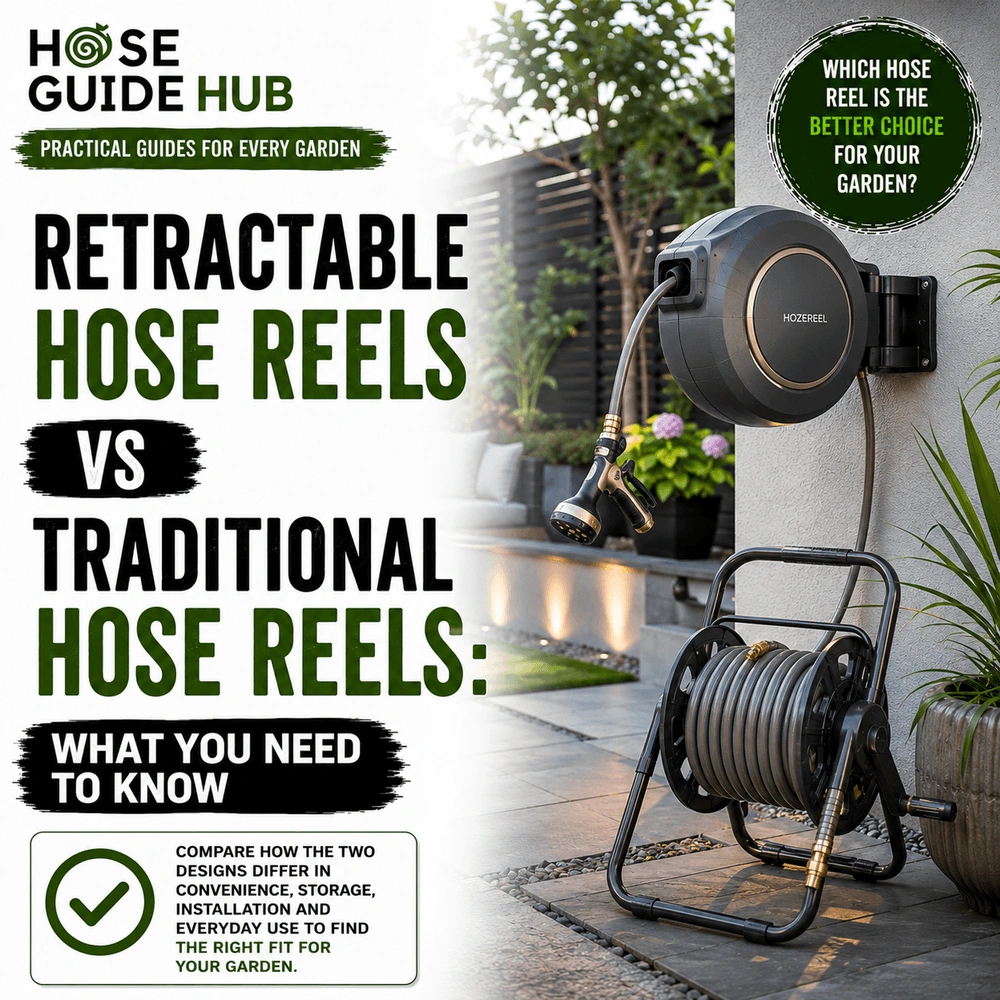
Retractable Hose Reels vs Traditional Hose Reels: What You Need To Know
Which type actually suits your garden, your budget, and how you work? That depends on more than just convenience.
This guide covers everything you need to make a confident decision: how each type works, what it costs, where each one genuinely excels, and the real-world scenarios where one outperforms the other. So let’s look at retractable hose reels vs traditional hose reels.
Disclosure: As an Amazon Associate, we earn from qualifying purchases made through links on this site. Learn more.
How Each Type Actually Works
Retractable Hose Reels
A retractable hose reel uses a coiled spring mechanism inside an enclosed casing. You pull the hose out to the length you need, and a ratchet locking system holds it in place at that exact position. When you’re done, you give the hose a slight tug to release the lock, and the spring pulls it back in automatically.
Most residential models handle hose lengths from 50 ft to 155 ft and are rated for standard household water pressure (typically up to 150 PSI, with heavy-duty models reaching 300 to 600 PSI). The hose is pre-installed inside the unit and protected by the casing from sunlight, freezing temperatures, and physical damage. Most wall-mounted models also include a swivel bracket that rotates 180 degrees, so you can pull the hose out in any direction without repositioning the whole unit.
Traditional Hose Reels
A traditional hose reel is exactly what it sounds like: an open spool on a mounting frame. You feed your hose onto the drum manually, either by hand or using a crank handle. The hose winds around the drum and stays there until you pull it off again, re-winding it the same way when you’re finished.
Traditional reels come in wall-mounted fixed versions, freestanding models on casters, and rotating models where the drum sits below a swivel arm. The key difference from retractable units is that the hose is not enclosed, it winds openly on the drum, and retraction is always manual.
You also bring your own hose. Traditional reels are typically sold as frames only, so you can use whatever hose you already own or choose any replacement hose you like.
Feature-by-Feature Comparison
Here’s how the two types stack up across the factors that actually matter when you’re choosing:
| Feature | Retractable Hose Reel | Traditional Hose Reel |
| Hose retraction | Automatic (spring-loaded) | Manual crank or hand-coil |
| Setup | Wall-mount, drilling required | Wall-mount or freestanding |
| Hose included | Usually yes | Usually not |
| Hose length options | 50 ft to 155 ft | 25 ft to 300 ft+ |
| Maintenance | Spring/mechanism upkeep | Minimal — few moving parts |
| Hose compatibility | Fixed (pre-installed hose) | Works with any hose |
| UV protection | Enclosed casing protects hose | Hose exposed to elements |
| Portability | Fixed wall position | Some freestanding models mobile |
| Ideal for | Frequent, daily use | Occasional use, large properties |
| Repair complexity | Higher (internal mechanism) | Low (open frame) |
Pros and Cons: The Honest Version
Retractable Hose Reels
What they genuinely do well:
- Hose retracts in seconds with a single tug. No cranking, no coiling, no wrestling with 100 feet of PVC.
- The enclosed casing shields the hose from UV radiation, which is one of the primary causes of hose degradation. A hose stored inside a retractable reel typically lasts longer than one left exposed on a manual reel.
- The ratchet lock holds at any length, so you can pull out exactly 30 feet and lock it there without the hose either going slack or pulling back.
- Wall-mounted units free up floor space and keep garden areas tidy.
- The swivel bracket on most models gives you a wide arc of coverage from one mounting position.
Where they fall short:
- The internal spring mechanism is a wear point. Without regular maintenance (draining before winter, occasional lubrication of the mechanism), springs can weaken or fail. Good models can last 10+ years with proper care; neglected ones sometimes fail within two seasons.
- The hose is fixed. If you want to upgrade to a thicker 5/8-inch hose or switch to a rubber hose, you can’t swap it in without replacing the whole unit.
- Installation requires wall-mounting. You need to locate studs, use appropriate anchors, and drill. Skipping this step properly causes problems; a reel loaded with water pressure and a full hose is heavy.
- If the spring mechanism fails, repair is difficult. These units are more likely to be replaced than repaired.
Traditional Hose Reels
What they genuinely do well:
- Simple and reliable. Fewer moving parts means fewer things to break.
- You choose your hose. Rubber, PVC, expandable, heavy-duty 3/4-inch flow, 200 feet long. Traditional reels accommodate far more variety.
- Open-frame construction means they’re easy to clean, easy to inspect, and easy to repair if something does go wrong.
- Lower upfront cost, especially if you already own a hose.
- Some freestanding models with wheels let you move the reel around a large property, which no wall-mounted retractable unit can do.
Where they fall short:
- Rewinding a long hose by crank is slow and, for people with back or shoulder issues, genuinely uncomfortable.
- The hose sits exposed on the open drum. UV exposure and temperature fluctuations degrade hose material faster.
- Hoses on traditional reels are more prone to kinking, especially if wound unevenly or if the hose is cold and stiff.
- They look messier. An open spool with hose wound around it doesn’t have the clean appearance of an enclosed retractable unit.
Who Should Buy Which Type?
This is ultimately the only question that matters. Both types are well-made at the upper end of their respective price ranges. The decision comes down to how you actually use a hose.
| Buy Retractable If… | Buy Traditional If… |
| You water daily or multiple times a week | You water occasionally |
| You have mobility or back issues | You want to use your existing favourite hose |
| Tidiness and curb appeal matter to you | You need very long hose runs (150ft+) |
| You have a fixed watering location | You prefer simpler, repairable equipment |
Real-World Scenarios
Scenario 1: The Daily Gardener
You water your vegetable beds, pots, and lawn every morning. You’re using the hose six or seven times a week across 30 to 40 minutes of watering. In this case, a retractable reel pays for itself in convenience almost immediately. The time you spend manually rewinding a 100-foot hose adds up to hours over a season. More importantly, repeatedly dragging and re-coiling a hose puts physical strain on you and mechanical stress on the hose. A retractable unit makes the whole routine noticeably faster.
Scenario 2: The Weekend Car Washer
You wash the car on Saturdays and occasionally water some potted plants. Usage is light and infrequent. A traditional reel with a 50-foot hose is perfectly adequate here. You’ll spend $30 to $50, it’ll work reliably for years, and the occasional effort of manually rewinding 50 feet of hose won’t bother you much.
Scenario 3: Large Property with Long Hose Runs
You have a large yard and need 150 feet or more of hose reach. This is one area where traditional reels have a practical edge. Most retractable units cap out at 130 to 155 feet, and at that length the spring mechanism is doing a lot of work. Heavy steel traditional reels can hold considerably more hose without the same mechanical stress, and you can choose a high-flow 5/8-inch or 3/4-inch hose to minimise pressure loss over that distance.
Scenario 4: Older Gardener or Anyone with Joint Issues
Manual rewinding of a heavy hose is not a neutral act. If you have wrist, shoulder, or lower-back issues, the repetitive cranking motion on a traditional reel adds up. A retractable unit with a slow-return mechanism takes that task entirely off the table. This is probably the most compelling functional case for spending more on a retractable model.
Key Features to Look for When Buying
For Retractable Hose Reels
- Slow-return mechanism: prevents the hose from whipping back fast, which damages the hose and can be dangerous. This should be a non-negotiable feature.
- Brass fittings: plastic connectors at the water inlet corrode and crack. Brass fittings last significantly longer and hold a better seal.
- Hose diameter: 1/2-inch is standard for most garden tasks; 5/8-inch delivers about 40% more water flow and is better for larger areas.
- PSI rating: standard household pressure is typically 40 to 80 PSI. Make sure the unit’s rating exceeds your water supply pressure by a comfortable margin.
- Swivel bracket angle: most offer 180 degrees; some premium models go to 210 degrees. More range means more coverage from one mounting point.
- Warranty: reputable brands offer 2 years minimum. Longer warranties signal confidence in the spring mechanism’s durability.
For Traditional Hose Reels
- Material: steel over plastic, always. Look for powder-coat or stainless steel finishes for outdoor use.
- Crank handle quality: it should turn smoothly without binding. Ergonomic grips make a difference if you’re winding frequently.
- Hose capacity: check the reel’s rated capacity matches your hose diameter and length. Overfilling causes uneven winding and stress on the drum.
- Swivel capability: rotating mount arms let you pull the hose in a wider arc without dragging the reel.
- Hose guide: a built-in guide that tracks the hose evenly across the drum prevents bunching on one side and reduces kinking.
Maintenance: What Each Type Needs
Retractable Reel Maintenance
The most important maintenance step for retractable reels is winterising. Before the first freeze, drain the hose completely, disconnect the water supply, and cycle the retraction mechanism five or six times while spraying silicone lubricant on all moving components. This keeps the spring tension even and prevents the internal seals from stiffening. Skipping this step is the most common cause of early spring failure. Done properly, a quality retractable reel should last 8 to 10 years.
Traditional Reel Maintenance
Traditional reels need very little. Rinse the drum periodically to remove soil and grit. If the frame is steel, check for rust annually and touch up with rust-inhibiting paint if needed. The crank mechanism benefits from an occasional drop of oil to keep it turning freely. Drain and coil the hose loosely off the reel if you’re in a freezing climate, as hose damage from ice expansion is the main risk. Properly maintained metal traditional reels can last well over a decade.
Frequently Asked Questions
Do retractable hose reels work with any nozzle?
Yes. Most retractable reels use standard hose thread fittings (GHT, 3/4-inch) and are compatible with common nozzles, sprinklers, and spray guns. Some brands also include a multi-pattern nozzle in the box.
Can a retractable hose reel be used in cold climates?
Yes, but with preparation. Drain the hose after each use in freezing conditions, and winterise the unit before temperatures drop below 32°F. Many units are rated from -4°F to 122°F, but ice inside a sealed casing can still damage internal components if water isn’t fully drained.
How do I know what hose length I need?
Measure the distance from your outdoor tap to the furthest point you need to reach, then add 20 to 25 feet for slack. For most standard suburban gardens, 65 to 100 feet covers the whole property from one or two mounting positions. Larger properties typically need 100 to 130 feet.
Is a retractable hose reel harder to install than a traditional one?
Slightly, yes. Wall-mounted traditional reels also require drilling, but retractable units are heavier once the hose is filled with water and under pressure. You must mount into wall studs or use a mounting board to distribute the load across the wall surface. Mounting into vinyl siding without finding studs is a common mistake that causes the reel to pull out under load.
Can I replace the hose in a retractable reel?
On most consumer-grade models, no. The hose is integral to the unit and not designed to be swapped. Some commercial or heavy-duty retractable reels do allow hose replacement, but these are significantly more expensive. If hose replaceability matters to you, a traditional reel is the better choice.
Conclusion
The retractable vs traditional debate doesn’t have a single winner because the two types solve different problems. Retractable reels make daily watering faster, neater, and easier on your body. They protect the hose better, look cleaner mounted on a wall, and remove most of the friction from routine garden tasks. The trade-off is higher cost, fixed hose compatibility, and a mechanism that requires occasional care to stay reliable.
Traditional reels are the practical choice when you want simplicity, total control over your hose selection, or maximum hose length at minimum cost. They’re repairable, flexible, and durable when built from quality steel. They ask more physical effort from you but demand very little maintenance in return.
If you water frequently and want the job done as quickly and painlessly as possible, spend $120 to $160 on a solid retractable reel with brass fittings and a slow-return mechanism. You won’t regret it. If you water occasionally and already own a hose you like, a good steel manual reel in the $40 to $80 range is all you need.
Check out our best hose reel cart with wheels post next.