
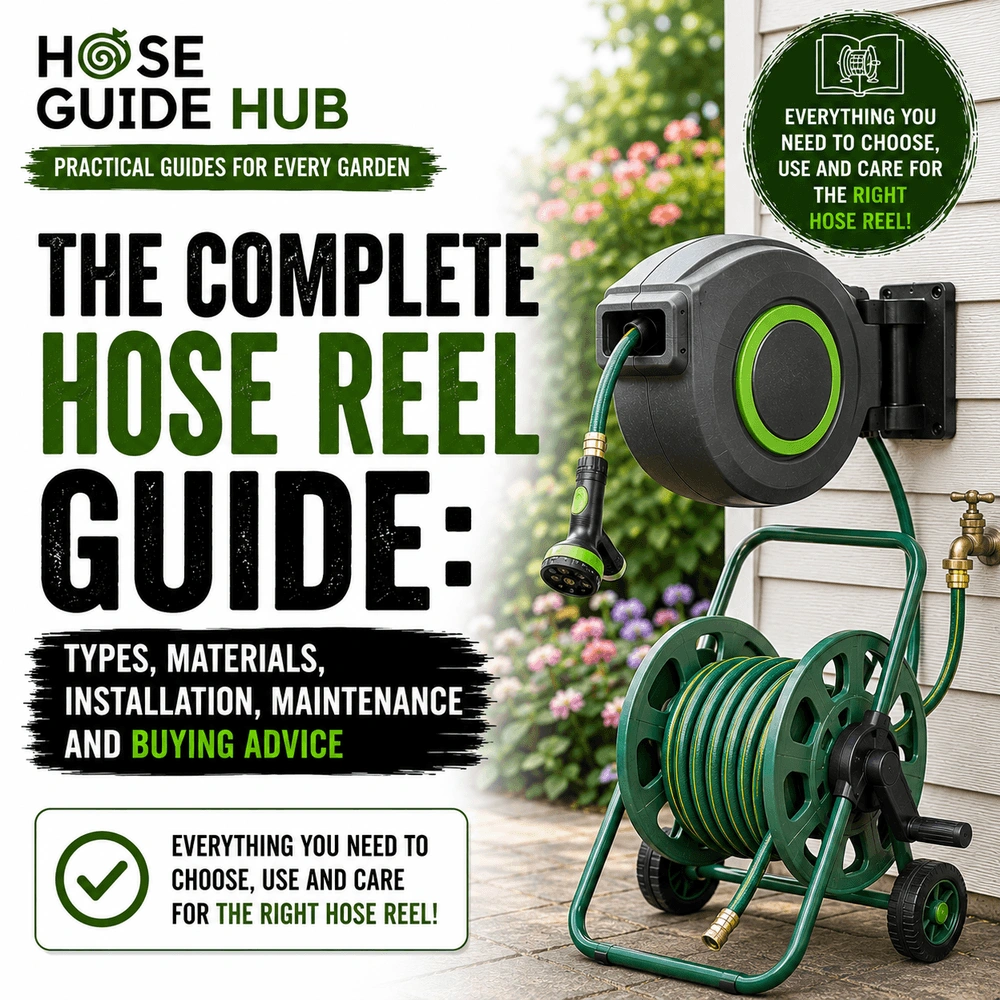
The Complete Hose Reel Guide: Types, Materials, Installation, Maintenance And Buying Advice
If you’ve ever spent ten minutes fighting a tangled garden hose before you’ve even started watering, you already know the problem. Hose reels solve it. But not all reels are built the same, and picking the wrong one costs you money, time, and patience.
Whether you’re watering a suburban backyard, running a pressure washer on a commercial site, or managing irrigation on an agricultural property, there’s a hose reel designed for that job. Let’s sort out which one is yours.
Disclosure: As an Amazon Associate, we earn from qualifying purchases made through links on this site. Learn more.
What Exactly Is a Hose Reel?
A hose reel is a cylindrical or drum-shaped device designed to wind, store, and dispense a hose in a controlled way. The core idea is simple: instead of leaving a hose coiled on the ground where it kinks, trips people up, and degrades from UV exposure, you store it neatly on a rotating drum. You pull out what you need, use it, and wind it back up when you’re done.
The reel sits on a frame, which can be mounted to a wall, set on the ground, or fitted with wheels. A swivel joint at the centre lets the drum rotate freely while the water supply stays connected. That swivel is one of the most important components in any reel; if it’s made of cheap materials, it leaks and fails quickly.
Hose reels are used everywhere from home gardens to fire suppression systems, automotive workshops, agricultural irrigation, and commercial cleaning operations. The scale changes, but the principle stays the same.
Types of Hose Reels: A Full Breakdown
The type of reel you need depends on how often you use it, where you use it, and how much hose you need to manage. Here are the main categories:
1. Wall-Mounted Hose Reels
These bolt directly onto an exterior wall, fence, or post near your outdoor tap. The hose stays off the ground at all times and the reel swings out when you need access. Wall-mounted models are the most popular choice for home gardens because they’re out of the way, look tidy, and don’t take up floor space.
Most wall-mounted reels can hold between 25 and 100 feet of standard garden hose. They come in both manual crank and automatic retractable versions. Installation takes about 30 minutes if you have a power drill and know where your wall studs are.
2. Retractable Hose Reels
Retractable reels use an internal spring mechanism to automatically wind the hose back in when you’re done. You pull the hose to the length you need, give it a slight tug to lock it in position, and when you’re finished, another tug releases the lock and the spring pulls the hose back onto the drum. No cranking, no manually coiling.
These are the most convenient option for regular garden use. The quality of the spring and the internal guide mechanism determines how long they last. Budget retractable reels often have the spring fail within a year or two; better models use a stainless-steel spring and last a decade or more.
3. Portable and Wheeled Hose Reels
If your garden is large, oddly shaped, or you need to move the reel between multiple access points, a wheeled model makes sense. These sit on a base with two or four wheels and a handle, so you can roll them around the property and park them wherever the tap is.
Wheeled reels typically hold more hose than wall-mounted models, often up to 200 feet or more on commercial versions. The downside is storage; they take up floor space and have to be put somewhere when not in use.
4. Hose Cart Reels
A hose cart is a wheeled reel with a larger, sturdier frame and sometimes a shelf or basket for accessories like spray nozzles and gloves. They’re essentially the premium version of a wheeled reel, designed for gardeners who use their hose frequently and want everything in one organised unit.
5. Ceiling-Mounted Hose Reels
Common in garages, workshops, and commercial car wash bays, ceiling-mounted reels hang overhead and drop down when needed. They keep floor space completely clear and work well for air hoses, pressure washer hoses, and water lines in enclosed spaces. Installation requires solid structural support above the mounting point.
6. Manual Crank Hose Reels
The traditional type. A handle on the side of the drum lets you wind the hose back in by hand. Manual reels are more affordable than retractable models and have fewer moving parts to fail. For occasional users, a good manual reel can outlast a cheap retractable one by years.
7. Industrial and Commercial Hose Reels
Heavy-duty versions built for professional use, high-pressure applications, or long hose runs. These are made from steel or stainless steel, handle higher PSI ratings, and are often ceiling or wall-mounted in fixed positions. Brands like Reelcraft and COXREELS are the industry benchmarks at this end of the market.
Hose Reel Types at a Glance
| Type | Best For | Typical Hose Capacity |
| Wall-Mounted | Home gardens, fixed use | 25-100 ft |
| Retractable | Convenience, frequent use | 50-130 ft |
| Wheeled/Portable | Large gardens, multiple taps | 100-200+ ft |
| Hose Cart | Regular gardeners, all-in-one | 100-150 ft |
| Ceiling-Mounted | Garages, workshops, car bays | 50-150 ft |
| Manual Crank | Budget use, occasional watering | 25-100 ft |
| Industrial/Commercial | Worksites, farms, high-pressure | 200-500+ ft |
Materials: What Your Hose Reel Is Made Of Matters
The frame material is the single biggest factor in how long a hose reel lasts. Every manufacturer has a marketing angle, so here’s what the materials actually mean in practice:
Plastic (Resin/ABS)
The most affordable option and the most common in the entry-level market. Plastic reels are lightweight, rust-proof by nature, and available in various colours. The problem is UV degradation. In sunny climates, cheaper plastics become brittle within a few years, and the mounting points can crack under load. Better plastic reels use UV-stabilised resin or ABS, which holds up significantly longer.
Plastic is a reasonable choice if you’re watering a small garden, live in a moderate climate, and don’t want to spend much. For heavy daily use or harsh outdoor conditions, it’s not the right long-term investment.
Steel
Standard steel reels are heavier and stronger than plastic but require a protective coating to resist rust. Most steel reels are powder-coated or galvanised. A good powder coat holds up well for years; a thin cheap coating starts flaking within one or two seasons, especially in wet climates. Steel is about 2.5 times denser than aluminium, which makes steel reels noticeably heavier to move.
Powder-coated steel is a solid choice for a fixed wall-mount reel where weight doesn’t matter and the reel is sheltered from direct rain.
Stainless Steel
The premium choice for corrosion resistance. Stainless steel reels handle coastal environments, chemical exposure, marine applications, and high-humidity conditions without the rust risk that comes with regular steel. They’re used heavily in commercial settings, food processing facilities, and offshore equipment where corrosion would be a serious problem.
The trade-off is weight and cost. Stainless steel reels are heavier than both aluminium and standard steel alternatives, and they cost more upfront. For a home garden in a non-coastal area, they’re overkill. For a seaside property or a professional cleaning operation with chemical exposure, they’re the right call.
Aluminium Alloy
Aluminium sits in a sweet spot for most applications. It’s approximately 2.5 times lighter than steel, naturally corrosion-resistant without needing a coating, and strong enough to handle significant hose loads. Most quality home and semi-commercial reels use an aluminium alloy, which combines aluminium with iron, copper, magnesium, silicon, and zinc for additional strength.
Aluminium reels are easier to move, install, and handle than steel equivalents. For wheeled reels, vehicle-mounted systems, and mobile service equipment, aluminium is typically the default choice. The one area where aluminium falls behind is in the very highest-pressure or harshest chemical environments, where stainless steel takes over.
Material Comparison
| Material | Weight | Corrosion Resistance | Durability | Best Environment | Cost |
| Plastic (ABS/Resin) | Very Light | Good (if UV-stabilised) | Moderate | Mild climate, light use | Low |
| Steel (Powder-coated) | Heavy | Moderate (needs coating) | High | Sheltered, fixed mounts | Medium |
| Stainless Steel | Very Heavy | Excellent | Very High | Coastal, chemical, marine | High |
| Aluminium Alloy | Light | Very Good | High | Most outdoor environments | Medium-High |
How to Choose the Right Hose Reel: A Buyer’s Framework
Before you look at a single product listing, work through these four questions:
1. How much hose do you actually need?
Measure the longest distance from your outdoor tap to the furthest point in your garden or workspace. Add 10 to 15 feet for slack. That’s your minimum hose length. Don’t buy a 50-foot reel for a property that needs 80 feet of reach; you’ll just end up dragging the whole reel around, which defeats the purpose.
Standard garden hose diameters are 1/2 inch, 5/8 inch, and 3/4 inch. The 5/8-inch diameter is the most common for residential use and offers a good balance of flow rate and manageability. Wider hoses are heavier and stiffer, which affects how a reel winds and unwinds.
2. Where is it going to live?
A fixed location near the tap suits a wall-mounted reel. A large open garden where you need to cover multiple zones suits a wheeled cart. A garage or workshop where floor space is premium suits a ceiling mount. Getting this right first narrows your options considerably.
Consider the mounting surface too. Brick and masonry walls need masonry drill bits and appropriate anchors. Timber studs behind plasterboard need longer screws that reach the stud. Never mount a hose reel loaded with 20 pounds of water into hollow plasterboard alone.
3. How often will you use it?
Daily watering justifies spending more on a quality retractable reel with a stainless-steel spring and a UV-stabilised casing. Once a week watering sessions during summer can be handled fine by a decent manual crank model at half the price. Frequency of use is the clearest indicator of how much quality you actually need.
4. What’s the pressure rating?
Most residential garden hoses operate at 40 to 80 PSI. Standard home garden hose reels are designed for exactly this range. If you’re connecting a pressure washer, you need a reel rated for the output of that machine. Many pressure washers run at 1,500 to 3,000 PSI; a standard garden hose reel will fail at those pressures. Always check the PSI rating on the reel before connecting anything other than a garden hose.
| Key Features to Look for When Buying a Hose Reel: Swivel joint quality: should be brass or stainless steel, not cheap pot metal Hose guide arm: keeps the hose winding evenly and prevents bunching at one side Locking mechanism on retractable models: should click firmly and release cleanly Spring material on retractable reels: stainless steel springs last far longer than standard steel UV-stabilised casing on plastic or resin models Weight capacity of mounting hardware (a full hose with water weighs 15-20 lbs) Inlet/outlet fittings: standard 3/4 inch NPT or BSP thread for compatibility Swivel range: 180-degree swivel is standard, 360-degree suits ceiling mounts |
How to Install a Wall-Mounted Hose Reel
Wall mounting is the most common installation type. Follow these steps and you’ll have it done in under an hour:
What You’ll Need
- Power drill with masonry or wood bit (depending on wall type)
- Spirit level
- Pencil or chalk for marking
- Screwdriver
- Mounting hardware (usually included with the reel)
- Silicone caulk (for sealing holes in wood or masonry)
- Teflon tape for threaded water connections
Step-by-Step Installation
- Choose your location. Mount as close to the outdoor tap as possible. Aim for waist-to-chest height (roughly 4 feet from the ground) for comfortable operation. Check there’s enough clearance around the reel for it to rotate and for the hose to extend freely without rubbing on walls or plants.
- Mark the holes. Hold the mounting bracket against the wall and use a spirit level to confirm it’s straight. Mark the drill points with a pencil.
- Drill the holes. For masonry or brick, use a masonry bit and insert wall plugs (anchors). For timber studs, drill directly and use the provided screws. Apply a small amount of silicone caulk around each hole before inserting the anchor to keep water out.
- Attach the bracket. Screw the mounting bracket to the wall. Don’t overtighten as this can crack plastic components. The bracket should sit flush and feel completely solid with no movement.
- Mount the reel onto the bracket. Most reels click or hook onto the bracket. Secure with any included bolts or locking pins.
- Connect the water supply. Wrap the threaded inlet fitting with two or three layers of Teflon tape before connecting to the tap. Hand-tighten first, then use a wrench for a quarter turn more. Don’t force it.
- Test it. Turn the tap on and check every connection for leaks. Pull the hose out to its full length and retract it several times to confirm smooth operation. Check that the hose doesn’t rub against any surface during extension.
| Pro Installation Tips: Always drill into a wall stud or use rated masonry anchors, never rely on plasterboard alone Mount 6 to 8 inches away from the wall surface to give the reel clearance to spin freely If you see any wobble after tightening, replace the anchor, don’t just overtighten For reel rotation to work freely, check the reel doesn’t contact the wall on either side of its swing Seal all drill holes with silicone even if the hole is hidden by the bracket |
Maintaining Your Hose Reel
A well-maintained hose reel runs for a decade or more. Neglected, even a quality reel deteriorates fast. None of this takes long:
Regular Checks (Every Month During Active Use)
- Wipe the reel drum with a damp cloth to remove soil, algae, and debris
- Check the swivel joint for drips when the tap is on
- Pull the hose out fully and check for kinks, cracks, or worn patches near the fittings
- Test the locking mechanism on retractable models; it should click and hold without slipping
Seasonal Maintenance
- Lubricate the swivel joint and any exposed metal pivot points with a silicone spray or light machine oil
- Inspect mounting screws and anchors; weather and vibration loosen them over time, tighten anything that has shifted
- Check the hose guide arm is aligned; a misaligned arm causes the hose to bunch on one side and eventually jams the reel
- Before winter, drain the hose completely and store in a sheltered spot if temperatures drop below freezing
Common Problems and Fixes
| Problem | Likely Cause | Fix |
| Hose won’t retract fully | Weak spring or hose bunched on drum | Re-spool the hose evenly by hand; replace spring if worn |
| Leak at swivel joint | Worn O-ring or overtightened fitting | Replace O-ring; use Teflon tape on threads |
| Hose kinks near reel exit | Hose guide arm misaligned | Adjust guide arm angle; check hose diameter compatibility |
| Reel rotates stiffly | Debris in pivot bearing or dry joint | Clean the pivot, apply silicone lubricant |
| Mounting bracket wobbles | Loose anchors or damaged wall | Replace anchors, drill into solid material |
| Reel lock slips on retractable | Worn latch pawl or spring | Contact manufacturer for replacement parts |
Garden Hose Reels vs Industrial Hose Reels
These are two very different product categories that share the same name. Knowing the difference saves you from buying the wrong thing:
| Feature | Garden Hose Reel | Industrial Hose Reel |
| Pressure Rating | 40-80 PSI | Up to 4,000+ PSI |
| Hose Diameter | 1/2″ to 3/4″ | 3/8″ to 1″ or larger |
| Hose Length | 25-150 ft | 100-500+ ft |
| Material | Plastic or aluminium alloy | Steel, stainless steel |
| Mounting | Wall, post, cart | Wall, ceiling, floor, vehicle |
| Typical Use | Garden watering, domestic cleaning | Pressure washing, fire suppression, aviation, farming |
| Price Range | $30-$350 | $200-$2,000+ |
| Service Life | 3-10 years | 10-25+ years with maintenance |
Which Hose Reel for Which Situation?
Small Suburban Garden (Under 50 feet of reach)
A wall-mounted manual crank or entry-level retractable reel in resin or aluminium handles this perfectly. You don’t need to spend more than $80 to $120. Look for a model with a brass swivel rather than plastic, and UV-stabilised casing if it’ll be in direct sun.
Large Garden or Acreage
A wheeled hose cart with at least 100 feet of hose, or two wall-mounted reels at different access points. If budget allows, a retractable wall-mount with a long hose run is more convenient than carting a wheeled reel around. Models from brands like Giraffe Tools offer up to 130 feet of retractable hose.
Garage or Home Workshop
A ceiling-mounted reel keeps the floor clear and drops down exactly where you need it. For air hoses (compressor lines), check the PSI rating carefully; standard garden reels are incompatible with compressed air lines. Look for a dedicated air hose reel rated for at least 300 PSI.
Pressure Washing
Never use a standard garden hose reel for a pressure washer. The pressure ratings are incompatible and you risk the hose bursting or the reel failing under load. You need a reel specifically rated for pressure washing, typically above 3,000 PSI for domestic machines. These are available from suppliers like J Racenstein and VEVOR in both steel and stainless steel.
Coastal or Marine Environments
Stainless steel is the only sensible choice where salt air is constant. Powder-coated steel corrodes faster than you’d expect in coastal conditions, and aluminium can develop surface oxidation over time. If the reel will be outdoors within a few hundred metres of the ocean, spend the money on stainless.
Commercial Landscaping or Farming
High-cycle use demands high-quality reels. Look at commercial-grade aluminium or stainless-steel models from established industrial brands. The upfront cost is higher but the service life is measured in decades rather than years, and replacement parts are available.
| Quick Tips Before You Buy: Match the reel inlet thread to your outdoor tap. In the UK and Australia, BSP (British Standard Pipe) is standard. In the US, it’s NPT. Adapters exist but add potential leak points. Check the minimum bend radius of any included hose. A hose that bends too sharply at the reel exit will kink repeatedly at the same spot and fail early. For retractable reels, check the speed control mechanism. A slow-retract system prevents the hose snapping back and damaging plants or hitting you. Avoid reels with plastic swivel joints. Even on budget models, a brass swivel is worth the small extra cost. Read the warranty carefully. A 12-month warranty on a reel advertised to last ten years tells you something important about the manufacturer’s own confidence in the product. |
Reputable Hose Reel Brands Worth Knowing
| Brand | Known For | Best Product Category |
| Giraffe Tools | Retractable wall-mount reels for home use | Garden retractable, up to 130 ft |
| Eley | Premium aluminium alloy garden reels | Garden and commercial aluminium |
| Reelcraft | Industrial and professional reels | Commercial, high-pressure, air hose |
| COXREELS | Heavy-duty industrial reels | Industrial, vehicle-mount, high-cycle |
| Suncast | Mid-range garden reels and carts | Garden carts and wall-mount |
| Liberty Garden | Decorative cast aluminium reels | Aesthetic garden reels, medium duty |
| VEVOR | Budget-friendly commercial-grade options | Budget commercial and garden |
| Hoselink | UV-resistant retractable garden reels | Retractable wall-mount, garden |
Frequently Asked Questions
How long should a garden hose reel last?
A quality aluminium or steel reel with good maintenance lasts 8 to 15 years. A cheap plastic reel in a sunny location might last 3 to 5 years before the casing becomes brittle. Retractable mechanisms are the weak link on spring-loaded models; the spring quality determines when you’ll need to replace or repair it.
Can I leave my hose reel outside year-round?
Most metal and UV-stabilised reels handle year-round outdoor exposure. The hose itself is often more vulnerable than the reel. In freezing climates, drain all water from the hose and reel before temperatures drop below 0°C (32°F) to prevent fittings and swivel joints from cracking when the water inside expands as ice.
What’s the difference between a hose reel and a hose pot?
A hose pot is a decorative container that you drop the hose into with no winding mechanism. It looks tidier than a hose on the ground but doesn’t organise the hose in any structured way. A hose reel actually winds the hose onto a drum, which prevents kinks, extends hose life, and makes dispensing and retrieval much faster.
Will a retractable reel work with any hose?
Not always. Retractable reels are rated for a specific hose diameter and length. If the hose is too thick, it won’t wind evenly. If it’s too long, the spring won’t have enough tension to retract it fully. Many retractable reels come with a hose included; replacing that hose with a different diameter or length can compromise the system.
How do I stop my hose from kinking near the reel exit?
The most common cause is a hose that’s too stiff for the bend radius at the exit point. Check that the hose guide arm is properly adjusted to give the hose a gentle curve rather than a sharp angle. Some reels include a rubber or PVC anti-kink guide at the exit point; if yours doesn’t, aftermarket kink protectors are available for a few dollars.
Can I mount a hose reel on a brick wall?
Yes. Use a masonry drill bit to drill into the mortar joints rather than the brick face where possible, as mortar grips anchors better and is easier to patch if you ever remove the reel. Use masonry anchors rated for at least three times the weight of your loaded hose reel.
Conclusion
A good hose reel is one of those purchases that earns back its cost in convenience and hose longevity within the first season. The cheap plastic options from discount stores often cost more in the long run than spending an extra $50 on something with a brass swivel and a UV-stable frame.
Start with your use case: how much reach you need, where the reel will live, and how often you’ll use it. Then match the material and mechanism to those requirements. If you’re watering a modest garden twice a week, a retractable aluminium wall-mount around the $100 to $150 mark will serve you well for years. If you’re running a commercial operation, don’t cut corners on grade.
Most hose problems, tangling, kinking, premature wear, early fitting failure, trace directly back to poor storage. A quality hose reel fixes all of that at once.
Check out our best portable hose reels post & industrial hose reel guide.