
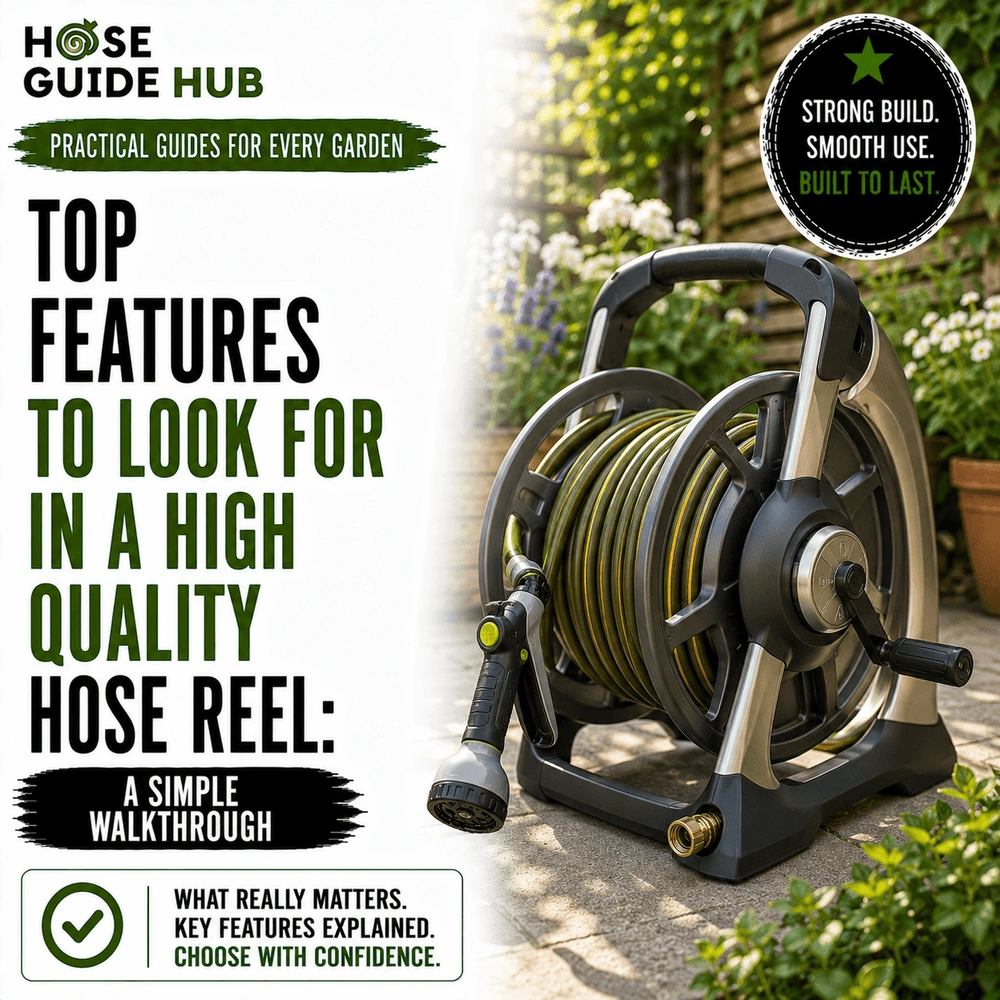
Top Features To Look For In A High Quality Hose Reel: A Simple Walkthrough
The top features to look for in a high quality hose reel go well beyond the price tag on the box. Material, capacity, swivel range, retraction mechanism, and fitting quality all matter, and getting even one of these wrong means frustration every single time you water the garden or wash the car.
Let’s breaks down exactly what separates a reel you’ll use for a decade from one you’ll bin after two seasons. Whether you’re mounting something on a garage wall or shopping for a portable cart to tow across a commercial property, you’ll find what you need here.
Disclosure: As an Amazon Associate, we earn from qualifying purchases made through links on this site. Learn more.
Understanding the Types of Hose Reels
Before you focus on individual features, you need to know which type of reel suits your situation. The three common categories are retractable, manual crank, and cart-style, and each suits a different kind of user.
| Feature | Retractable | Manual Crank | Cart / Portable |
| Ease of use | Excellent | Good | Good |
| Max hose capacity | Up to 130 ft | Up to 300 ft | Up to 300 ft |
| Best for | Home gardens | Farms / commercial | Large properties |
| Price range | $80 – $250+ | $40 – $150 | $50 – $200 |
| Hose protection | Excellent | Good | Moderate |
| Installation | Wall-mounted | Wall or post | No install needed |
Retractable Hose Reels
A retractable reel uses a spring-loaded mechanism inside the housing. You pull the hose to your desired length, give it a short tug to lock it, and when you’re done, another tug disengages the lock and the spring retracts the hose automatically in around 20 seconds. The better models include a slow-return damper so the hose doesn’t snap back at speed and risk kinking or whipping. These are the dominant choice for homeowners who want convenience and a tidy wall installation.
Manual Crank Reels
Manual reels use a hand crank to wind the hose back onto the drum. They’re simpler, more repairable, and can typically handle longer and heavier hoses than retractable models. If you’re running 200 feet of heavy-duty rubber hose on a farm or commercial site, a crank reel is far more reliable than a spring mechanism. The trade-off is time and effort, especially after a long day’s work.
Cart-Style Portable Reels
Carts give you mobility. Large wheels (10 inches or more) roll over uneven ground easily, and the best models use steel axles and foam-padded handles for comfort. If you need to move the reel around a large property rather than pulling hose to every corner, a cart reel makes sense. Liberty Garden’s heavy-duty cart is a widely tested example that holds up to 300 feet of 5/8-inch hose on a tubular steel frame with a powder-coated finish.
The Top Features to Look for in a High Quality Hose Reel
1. Frame and Housing Material
This is where cheap reels fail first. Prolonged sun exposure, frost cycles, and constant moisture contact will destroy low-grade materials within a season or two. Here’s how the main options compare:
| Material | Durability | Weight | Rust Risk | Best For |
| Stainless Steel | Excellent | Heavy | Very low | Coastal / industrial |
| Powder-coated Steel | Very good | Heavy | Low (if intact) | Heavy-duty home use |
| Aluminum Alloy | Good | Light | Very low | Mobile / vehicle use |
| High-density Plastic | Moderate | Light | None | Budget home gardens |
| Brass (fittings) | Excellent | Moderate | Very low | All connection points |
For most homeowners, powder-coated steel or stainless steel offers the best combination of strength and longevity. Aluminum alloy is the standout for portable applications where weight matters, since steel is roughly 2.5 times denser than aluminum. High-density plastic is only appropriate for light, infrequent use in mild climates.
2. Fitting Quality: Brass or Nothing
Every connection point on a hose reel is a potential leak. Cheap plastic fittings crack under tension, especially when a hose is attached and the temperature drops. Brass fittings are the clear choice: they handle moisture without corroding, they don’t deform when tightened, and they last far longer under pressure. This applies to the inlet connection, the swivel joint, and the outlet where the hose attaches.
A 90-degree swivel fitting at the water inlet is particularly valuable. It prevents the supply hose from bending sharply at the connection point, which is a common cause of leaks and premature wear.
3. Swivel Range and Rotation
A fixed-mount reel that can’t rotate forces you to either stretch the hose at an awkward angle or reposition the entire reel. A 180-degree swivel bracket means you can pull the hose out to either side of the reel without fighting the mount. Some premium wall-mounted models offer 360-degree rotation, which is overkill for most home installations but extremely useful in commercial workshops where the reel sits in the middle of a workspace.
The swivel mechanism itself should lock into position during use. Loose, wobbly swivel joints wear out quickly and allow the reel to drift while you’re working, which gets annoying fast.
4. Hose Length and Diameter Capacity
Bigger isn’t always better here. A reel designed for 65 feet won’t store 100 feet cleanly, and overloading a drum puts strain on the retraction spring and the axle. Know your coverage area before buying.
- Small gardens and patios (up to 30 ft): A 50 to 65 ft reel gives you working length plus comfortable storage margin.
- Average suburban homes: 80 to 100 ft is the most practical range, covering most standard lots with room for maneuvering.
- Large properties and commercial use: 130 to 300 ft reels are available. At this scale, manual crank or cart models are more appropriate than spring-loaded retractable units.
Hose diameter matters too. Most residential reels accommodate 1/2-inch or 5/8-inch hose. The 5/8-inch diameter delivers higher water flow, which matters if you’re running a sprinkler or filling a tank quickly. A 1/2-inch hose creates less drag on a retraction spring, so many retractable reels use it to maintain reliable auto-rewind performance on longer runs.
5. Retraction Mechanism and Slow-Return System
On retractable reels, the spring is the heart of the unit. A quality spring should maintain consistent tension through at least 10,000 retraction cycles without losing pull. Some manufacturers specifically test and publish this figure; if they don’t mention it, that tells you something.
The slow-return system (sometimes called a speed limiter or damper) is the feature that separates a well-built retractable reel from a frustrating one. Without it, the spring pulls the hose back at full speed, which causes the hose to whip, kink, and slam into the housing. A good slow-return mechanism controls the rewind speed so the hose returns smoothly and evenly. The VEVOR range and Hoselink retractable reels are two commonly cited examples that include this.
The locking mechanism also matters. A quality reel should hold the hose firmly at any extended length without creeping back. Ratchet-style locking systems (as found in better air hose reels using 1045 high-carbon steel ratchet gears) offer the most precise hold and longest lifespan.
6. Mounting Options and Installation Hardware
Wall-mounted reels need to be genuinely secure. A 100-foot hose filled with water is heavy, and a reel that’s wobbly or pulling away from the wall is both frustrating and a safety issue. Check that the mounting bracket is steel, not plastic, and that the reel ships with proper hardware including expansion bolts or lag screws rated for masonry or timber.
Some reels include keyhole mounting slots, which let you hang the reel on pre-installed wall plugs without needing to drill with the reel in position. This is a small but genuinely useful design detail. For ceiling mounting in garages or workshops, look for reels with increased bracket spacing for structural flexibility.
7. Hose Guide and Even Winding
A hose that winds unevenly onto the drum creates pressure points and long-term wear. A hose guide (also called a level winder) distributes the hose across the drum in neat, even layers as you retract. Without it, the hose bunches in one spot, which eventually deforms the drum and causes premature failure.
On premium manual reels, the hose guide is driven by the crank mechanism so it moves automatically. On retractable reels, the guide is usually spring-tensioned. Either way, it’s a feature worth checking for specifically when comparing models.
8. UV Resistance and Weather Protection
Direct sun destroys plastic reels faster than almost any other environmental factor. Polypropylene and standard ABS plastic lose structural integrity after sustained UV exposure, becoming brittle and cracking. Look specifically for UV-stabilized casing on any reel that will spend its life outdoors. Hoselink uses this as a key selling point on their retractable reels, and it’s a legitimate differentiator.
For metal reels, the finish quality determines weather resistance. A powder-coated finish that’s properly cured is effective at preventing rust, but scratches or chips in the coating are entry points for corrosion. Galvanized steel components offer an additional layer of protection under the coating. For truly corrosive environments, only stainless steel or aluminum provides reliable long-term protection without maintenance.
9. Working Pressure Rating
Most municipal water systems deliver water at 40 to 80 PSI. Residential hose reels typically handle 8 bar (116 PSI), which is well above domestic mains pressure and provides a comfortable safety margin. For commercial or industrial applications using pressure washers or high-flow irrigation, you need reels rated significantly higher. Industrial reels often specify maximum working pressures of 300 PSI or more for air and water lines.
Don’t overlook this if you’re connecting a reel to a pressure washer. A reel rated for standard garden use will fail under washer pressure, and that failure can be sudden and messy.
10. Included Accessories and Storage
A nozzle compartment or side shelf is a thoughtful addition that makes day-to-day use more practical. You shouldn’t have to hunt for the spray gun you use every morning. Some reels include built-in nozzle storage hooks; Liberty Garden’s cart model includes a side shelf specifically for this.
Multi-pattern spray nozzles are commonly bundled with retractable reels. A 9 or 10-pattern nozzle covers most tasks from fine misting to a strong jet for cleaning, saving you a separate purchase. Check whether the included nozzle is a single-piece unit with a rotary head or a thumb-lever design; the latter is much easier to use one-handed.
Trusted Brands Worth Knowing
A few names consistently appear in expert reviews and long-term user feedback. They’re not the cheapest options, but they back up their pricing with build quality and warranty terms.
- Hoselink: View Hoselink Products
Australian brand, founded 1997. Known for no-leak fittings, UV-stabilized casing, stainless-steel hardware, and strong warranty support. Their retractable reels sit at the premium end of the home garden market.
- Liberty Garden: View Liberty Garden Products
Specializes in steel construction, both wall-mounted and cart-style. The powder-coated steel frames handle heavy hoses and large capacities (up to 300 feet) that most retractable reels can’t touch.
- Giraffe Tools: View Giraffe Tools Products
Offers both manual stainless-steel models and retractable versions. Their 130-foot retractable reel with 180-degree swivel and lockable hose consistently rates well in hands-on tests by sites like Bob Vila.
- Eley: Eley Hose Reels
Uses commercial-grade aluminum alloy construction. Their approach to material selection is methodical, and they make the case well for why aluminum outperforms steel in typical residential hose reel applications.
- VEVOR: View VEVOR Products
A more accessible price point with a wide range of wall-mounted retractable reels. They include slow-return systems on most models, which is notable at their price range.
Common Buying Mistakes to Avoid
- Buying for the hose you have instead of the hose you need. If you’ll add length later, buy the reel with headroom now.
- Ignoring fitting material. Plastic fittings on an otherwise solid reel are a point of failure waiting to happen.
- Assuming any retractable reel will handle heavy hoses. Long, heavy rubber hoses resist spring retraction. If your hose is particularly heavy or thick, a manual crank reel will serve you better.
- Mounting on a surface that can’t take the load. A full 100-foot 5/8-inch hose with water in it can weigh 15 pounds or more. The wall anchor matters as much as the reel bracket.
- Overlooking warranty terms. Quality manufacturers back their products for 5 to 10 years. Short warranties on mechanical components (springs, swivels, cranks) are a reliable signal of expected lifespan.
Quick Feature Checklist Before You Buy
- Frame is stainless steel, powder-coated steel, or aluminum alloy
- All water connection fittings are brass
- Swivel bracket rotates at least 180 degrees
- Hose capacity matches your coverage area with a 10-15% margin
- Retractable models specify a slow-return or speed-limiter system
- Reel includes a hose guide for even drum winding
- Housing is UV-stabilized if it will be exposed to direct sun
- Working pressure rating is appropriate for your water source
- Mounting hardware is included and rated for your wall type
- Warranty covers at least the retraction mechanism for 3+ years
Conclusion
A quality hose reel is one of those purchases where the quality gap between budget and mid-range is enormous, but the gap between mid-range and premium is much smaller. Spending a little more on brass fittings, a proper swivel bracket, and UV-resistant housing adds years to the lifespan and saves you the headache of replacing a cheaper unit every two or three seasons.
The features that matter most are the ones you’ll interact with every single day: how smoothly the hose deploys, whether it locks reliably at the length you need, and whether it retracts without drama. Get those right, and everything else is a bonus.
Check our best expandable garden hose reel review next.