
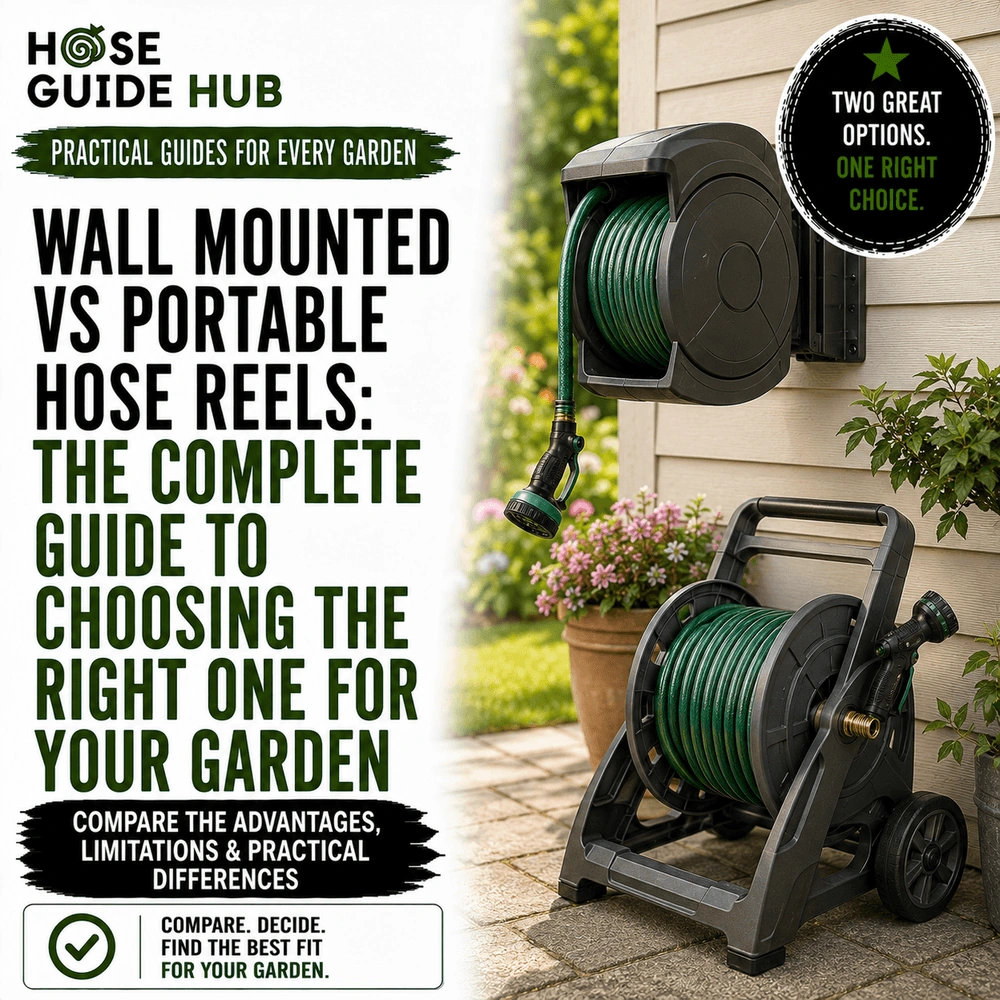
Wall Mounted vs Portable Hose Reels: The Complete Guide To Choosing The Right One For Your Garden
The debate between wall mounted vs portable hose reels isn’t as simple as it looks. Both types do the same basic job – store your garden hose neatly and make it easier to use but they suit very different gardens, watering habits, and outdoor setups. Pick the wrong one and you’ll either be wrestling a cart around a tight courtyard or frustratingly stretching a wall-fixed hose toward a veggie patch that’s 20 feet too far away.
This guide covers everything you need to know: how each type works, the real differences in capacity and design, who each one suits, and how to make a confident decision without second-guessing yourself later.
Disclosure: As an Amazon Associate, we earn from qualifying purchases made through links on this site. Learn more.
How Each Type Actually Works
Wall-Mounted Hose Reels
A wall-mounted hose reel bolts directly to an exterior wall, typically close to an outdoor tap. A lead-in hose (usually 5 to 6 feet, included with most models) connects the reel to the tap, so the water supply runs directly through the unit. When you want to water, you pull the hose out to the length you need, do the job, then wind it back up manually using a crank handle or, on retractable models, with a single tug.
Most wall-mounted reels swivel on a bracket, anywhere from 90 to 180 degrees so the hose can follow you around the garden without kinking or pulling. Standard models hold between 75 and 200 feet of 5/8 inch hose, which covers most residential gardens comfortably. The mount stays in place year round for many homeowners, though the reel drum can often be unclipped and brought inside during winter in colder climates.
Portable Hose Reels
Portable hose reels come in a few configurations: hand carry models (lighter, suited for small spaces), 2 wheel carts, and 4 wheel wagon style carts for heavy duty use. None of them require any wall mounting. You connect the lead-in hose to whichever outdoor tap is most convenient, use it, disconnect, and store the whole unit in a shed or garage.
Capacity tends to be higher on portable models. Two wheel cart reels typically hold 100 to 175 feet of 5/8 inch hose, while 4 wheel carts can manage 250 to 400 feet. Some premium wagon style reels from brands like Eley and Yard Butler use flat free turf tires and aluminum alloy frames built for rough outdoor terrain, not just paved surfaces.
Wall Mounted vs Portable Hose Reels: Side by Side Comparison
| Factor | Wall-Mounted Hose Reel | Portable Hose Reel |
| Mobility | Fixed in one location | Moves anywhere in the garden |
| Installation | Drilling required | No installation needed |
| Hose Capacity | 75 to 200 ft (5/8″ hose) | 100 to 400 ft (5/8″ hose) |
| Space Use | Saves floor/ground space | Takes up storage space |
| Best For | Small to medium gardens, one watering zone | Large gardens, multiple zones |
| Hose Protection | Excellent (elevated, off ground) | Good (depends on storage habits) |
| Setup Time | 30 to 60 mins (once only) | Instant, but tap connection needed each use |
| Ideal User | Homeowner with defined garden zone | Gardener with varied or large outdoor areas |
Wall-Mounted Hose Reels: The Full Picture
Pros and Cons
| Pros (Wall-Mounted) | Cons (Wall-Mounted) |
| Keeps hose off the ground, reducing kinks and wear | Fixed to one spot, can’t move it to another area |
| Neat, permanent setup with a clean look | Requires drilling into wall (DIY or professional) |
| No dragging or tangling when pulling hose out | Not suitable for renters or those who move often |
| Swivel models track you as you move around the garden | Hose length limits your reach from the mount point |
| Frees up floor and shed space | Some wall materials (brick, render) complicate installation |
| Easy daily access with no setup required | Not ideal for large gardens with multiple watering zones |
| Generally lower upfront cost than cart models |
Types of Wall-Mounted Reels
Not all wall-mounted reels are the same. The main variations are:
- Standard fixed mount: Bolts directly to the wall with no rotation. Simple and sturdy, good for watering a defined area directly in front.
- Swivel mount (90 to 180 degrees): The reel arm rotates, letting the hose sweep a much wider arc without you moving the reel. Far more practical for most gardens.
- Retractable wall-mounted: Spring loaded mechanism rewinds the hose automatically with a light tug. Fastest to use and the tidiest to look at, but typically the most expensive and with smaller hose capacity than manual reels.
- Enclosed/hidden wall reel: Houses the hose inside a box casing, fully concealing it. A popular choice where aesthetics matter, common on patios and modern courtyards.
Installation: What to Expect
Installing a wall-mounted hose reel is a straightforward DIY job for most people. You’ll need a drill, appropriate wall anchors for your surface type (masonry anchors for brick or render, standard wood screws for timber), a spirit level to get it straight, and about 30 to 60 minutes. Most reel manufacturers include mounting hardware in the box, though you may need different anchors depending on your wall material.
Mount the reel at roughly waist height, close to the outdoor tap, with the swivel arm facing the direction you’ll most often water. A good tip from Yard Butler: mount it slightly higher than waist height so you don’t have to crouch when winding the hose back on.
Brick walls and rendered surfaces do take more effort – you’ll need a masonry bit and hammer drill but the job is still well within DIY territory for most people. If you’re in a rental or have concerns about your wall type, a portable reel is the smarter choice.
Portable Hose Reels: The Full Picture
Pros and Cons
| Pros (Portable) | Cons (Portable) |
| Move it anywhere in the garden with no restrictions | Takes up more storage space when not in use |
| Zero installation required | Must connect/disconnect from tap with each use |
| Higher hose capacity available (up to 400 ft) | Heavier to transport when fully loaded with hose |
| Ideal for large properties or multiple watering areas | Plastic cart components can degrade in UV over time |
| Can be stored indoors easily to protect from frost | More moving parts means more potential failure points |
| Works across multiple tap locations | Higher cost for quality wheeled cart models |
| 4 wheel models handle rough terrain well |
Types of Portable Reels
- Hand carry portable reel: Lightweight, no wheels, typically holds 50 to 100 feet. Fine for small areas where you need occasional flexibility. Not great for heavy duty daily use.
- 2 wheel cart: The most common portable option. Easy to push across flat lawns and patios. Brands like Eley and Giraffe Tools offer models with 125 to 175 feet of capacity on a stainless or aluminum frame.
- 4 wheel wagon cart: Designed for larger gardens and rougher terrain. More stable on uneven ground, holds more hose (250 to 400 feet), and handles the weight of a fully loaded hose more comfortably. Higher price point, but built to last.
What to Look for in a Portable Reel
Build material matters more than price on portable carts. Plastic frames feel light and affordable but can crack and fade over a single Australian or US summer. Powder coated steel or aluminum alloy frames with brass fittings are the baseline for anything you expect to last more than two or three seasons. Eley’s commercial grade aluminum carts with flat free turf tires are a good benchmark for what a quality portable reel looks like.
Check the hose guide system too. A well designed hose guide keeps the hose winding evenly across the drum. Without one, the hose piles up on one side and makes rewinding a pain. Most mid range and premium carts include this.
Understanding Hose Capacity: What the Numbers Mean
Hose capacity is listed in feet (or metres) and usually refers to 5/8 inch diameter hose, which is the standard residential garden hose size. If you use ¾ inch hose (common for heavier flow), capacity will be less – typically about 20 to 25 percent less than the 5/8 inch figure.
Here’s a practical way to think about it: 75 feet of hose covers a small to medium backyard from a single mounting point. 100 to 125 feet covers most residential gardens comfortably. 150 to 200 feet lets you reach around a larger home without moving the reel. Anything above 200 feet is for acreage, farms, or properties with multiple separate zones.
Wall-mounted reels typically cap out at 200 feet of 5/8 inch hose. Portable carts can go well beyond that, with some models rated for 300 to 400 feet. If you genuinely need that kind of reach, a portable cart is the only practical option regardless of what else you prefer.
Which One Should You Buy?
| Choose Wall-Mounted If… | Choose Portable If… |
| You have a small or medium sized garden | You have a large property or acreage |
| All your watering happens in one zone | You water multiple separate areas |
| You want a tidy, permanent outdoor setup | You rent and can’t drill into walls |
| Hose storage is your main concern | You need 150+ feet of hose reach |
| You water frequently and want quick access | You want the reel stored in a garage or shed |
The clearest way to decide: think about how you actually use water in your garden. If you stand in roughly the same spot and water from one end to the other, a wall-mounted reel will serve you every single day with minimum effort. If you regularly move from the front garden to the back, around a shed, across a driveway, or out to a vegetable plot at the far end of the yard, a portable reel stops you fighting the hose.
Materials and Durability: What Lasts and What Doesn’t
Wall-Mounted Reel Materials
Powder coated steel is the most common material for wall-mounted reels and holds up well outdoors for 5 to 10 years with minimal maintenance. Stainless steel (304 grade) is the most durable – rust proof, UV resistant, and built to handle harsh conditions without surface degradation. Plastic wall-mounted reels are the cheapest option but tend to become brittle and crack within 2 to 4 years of UV exposure, especially in hot climates.
Fittings are worth checking separately. Brass connectors at the tap end and where the hose attaches to the reel are far more reliable than plastic fittings, which can crack under pressure or strip their threads after repeated connections. Most mid range and premium reels use brass; budget models often don’t.
Portable Reel Materials
The same principle applies to portable carts: plastic degrades, steel rusts without a quality powder coat, and aluminum alloy hits the sweet spot of light weight and long-term durability. Tires matter more than most buyers consider – plastic or rubber over steel tires work fine on flat concrete but become difficult to push across grass, gravel, or uneven ground. Flat free turf tires (pneumatic style, no puncture foam filled) roll smoothly on any surface and are a strong indicator of a well built portable reel overall.
Tips for Getting the Most Out of Your Hose Reel
- Always reel the hose back in without kinks. Feeding it back under light tension while cranking prevents it bunching and extends its lifespan significantly.
- For wall-mounted reels in cold climates: disconnect the lead-in hose from the tap before winter, drain the hose fully, and ideally bring the drum inside. Most swivel-mount drums unclip from the bracket for easy storage.
- Use a hose guide stake (a simple ground stake with a swivel eye) at corners of the garden to stop the hose cutting across beds and damaging plants when you pull it out.
- When mounting a wall reel, seal around the lag screws with exterior waterproof sealant if the wall is rendered or has any risk of moisture ingress behind the mounting plate.
- For portable carts: store them in a shed or garage when not in use, not left outside in full sun. Even quality powder coated finishes last longer when they’re not baking in UV every day.
- Check your tap thread before buying. Most Australian and US taps use 3/4 inch male thread. Most reels include a 3/4 inch to 5/8 inch adapter in the box, but it’s worth confirming before you purchase.
- If you’re buying a portable cart for a large property, go to the 4 wheel wagon version rather than the 2 wheel cart. Under the weight of 150+ feet of water filled hose, 2 wheel carts become difficult to tip and manoeuvre.
A Note on Retractable Reels
Retractable reels deserve a mention because they’ve become far more popular in the last decade, and many buyers get confused about whether retractable is a separate category from wall-mounted and portable. It’s not. Retractable is a mechanism, not a category. You can get retractable wall-mounted reels and retractable portable (ground-mounted or freestanding) reels.
The spring retract mechanism is genuinely convenient: pull out the hose, water, give it a slight tug, and the hose winds back in automatically. No manual cranking. The tradeoffs are higher cost, a lower hose capacity than equivalent manual reels (the spring mechanism takes up drum space), and a more complex product that has more parts to eventually wear out. For everyday home use, a good manual swivel reel is perfectly fine. If rewinding the hose feels like a chore you want to eliminate entirely, a retractable wall-mounted model is worth the extra cost.
Related Questions
Can I use a wall-mounted hose reel without drilling into a wall?
Most wall-mounted reels require drilling for a secure, permanent mount. Some brands sell standalone post-mount kits (Eley’s wood-post kit, for example) that let you mount the reel on a timber post set in the ground, avoiding any wall drilling while keeping the benefits of a fixed-position reel.
What is the maximum water pressure a hose reel can handle?
Most residential hose reels are rated for a maximum working pressure of 6 bar (around 87 PSI), with a burst or bearing pressure around 12 bar. Standard household mains water pressure sits between 1.5 and 4 bar, well within these limits.
Do hose reels come with a hose included?
Most don’t. A lead-in hose (5 to 6 feet, connecting the reel to the tap) is typically included, but the main garden hose is usually sold separately. Always check the product listing before purchasing if you’re expecting a complete setup out of the box.
Can I leave a hose reel outside year round?
Powder coated steel and stainless steel models are designed for permanent outdoor installation. In climates with hard frosts, you should drain the hose and reel fully before freezing temperatures arrive, and ideally bring the drum inside. Plastic models should be stored indoors during winter regardless of your climate.
Conclusion
Wall mounted vs portable hose reels is genuinely a horses for courses decision rather than one type being objectively better than the other. If your garden is compact, your watering is concentrated in one zone, and you want a tidy permanent setup that’s ready to use every morning, a wall-mounted reel is the right call. It keeps the hose off the ground, protects it from UV and foot traffic, and saves you connecting and disconnecting a hose cart every time you need to water.
If your property is large, you water in multiple areas, or you’re renting and can’t put screws in walls, a portable cart is the obvious answer. Go for a 2 wheel model if your garden is relatively flat and you need up to 175 feet. Step up to a 4 wheel wagon if you’re on rough terrain or need serious capacity.
Either way, prioritise build quality over the cheapest option available. A $40 plastic reel might seem like a bargain until it’s cracking and leaking 18 months later. A well built steel or aluminium reel, properly maintained, will outlast the hose it holds.
Check out our best wall mounted hose reel post.